TITLE: Warsh Says 2%. The 30-Year Says Prove It.
SUBTITLE: The Fed holds for a fifth straight meeting. The long end of the curve is running its own policy.
Market Snapshot
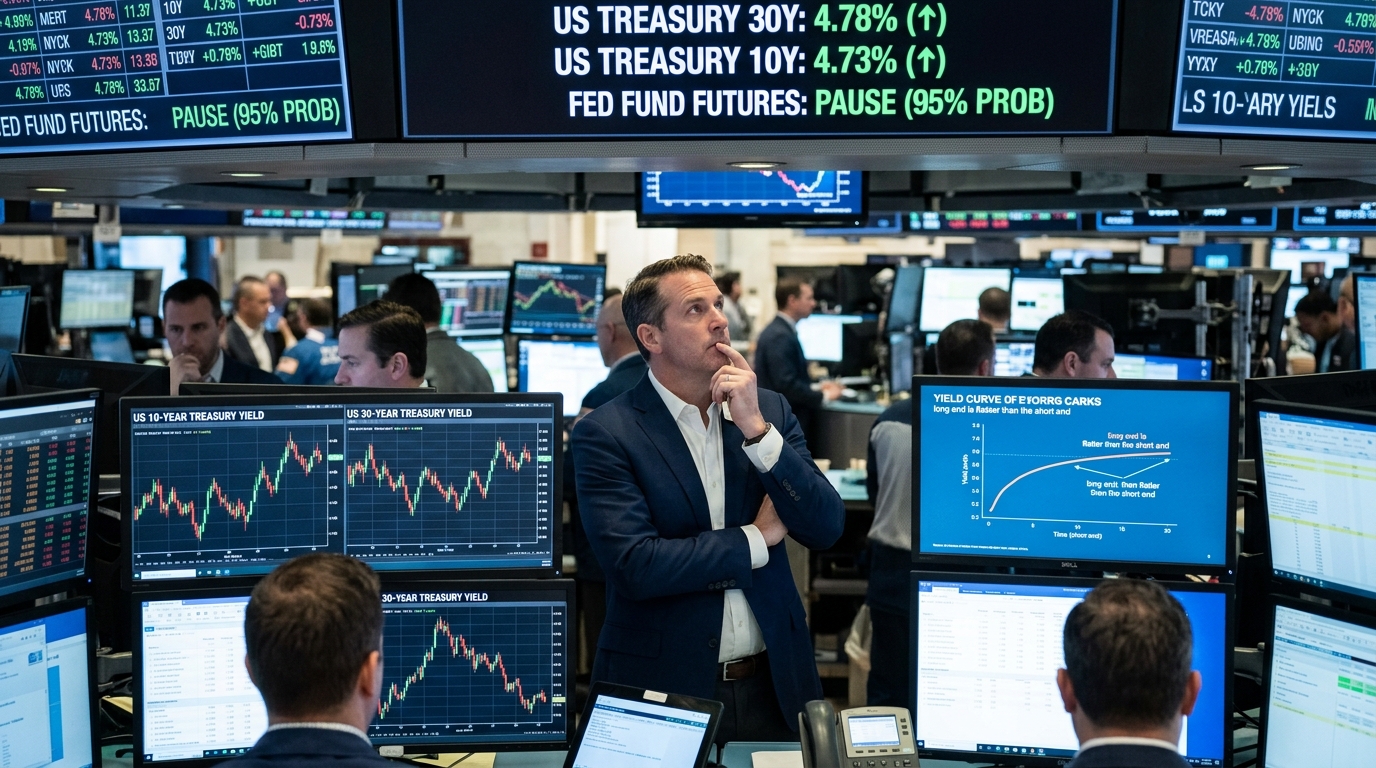
The 10-year Treasury yield rose to 4.73% on August 18, up 0.01 percentage points from the prior session. The implied probability of a hike at the September 16 meeting has fallen sharply since late July, yet over that same stretch the 30-year Treasury yield climbed from about 5.09% to 5.31%, its highest level since 2007. Those two facts do not belong in the same sentence if conventional rate logic holds. They are both true anyway.
At first glance, those moves look backward. If investors expect less tightening from the Fed, longer-term borrowing costs might be expected to ease. Instead, they are rising. That divergence is the actual story of this market right now, and it matters more than any single CPI reading.
- S&P 500 / Nasdaq: Equities under pressure from yield competition at the long end
- VIX: Elevated amid policy uncertainty ahead of Jackson Hole
- 30-Year Treasury: 5.31%, 19-year high
- 10-Year Treasury: 4.73%
- Crude: Near $80/bbl; Hormuz ceasefire talks deadlocked
- Gold: Near $4,350; CPI and PPI cooling has trimmed September hike odds
- University of Michigan year-ahead inflation expectations rose in August to 4.8%, up from 4.5% in July
Stocks in Focus
No single equity catalyst dominates today. The macro is the catalyst. Financials and rate-sensitive sectors face the most direct read-through from a 30-year yield at a 19-year high. Rate-sensitive growth names with long-duration cash flows are the most exposed if the long end holds here or moves higher after Jackson Hole.
Sector Watch
Financials: Regional banks have absorbed higher short rates, but the steepening between the 10-year and 30-year is complicating duration management across insurance and pension portfolios. Energy: The interim ceasefire memorandum of understanding between the U.S. and Iran has now expired, with negotiations to reopen the Strait of Hormuz still stalled, keeping oil elevated and feeding the inflation re-acceleration that is driving the long-end selloff. Utilities and REITs: Direct yield competition from Treasuries at these levels continues to weigh.
Catalyst Calendar
- August 20 (Thursday): FOMC July Minutes. The Fed voted 9-3 to hold rates steady at between 3.5% and 3.75% on July 29. The three dissenting members, Hammack of Cleveland, Kashkari of Minneapolis, and Logan of Dallas, each called for a 25 basis point hike. The minutes will show how close the majority came to joining them.
- August 26: Core PCE for July. July core and headline PCE prices are expected to remain above 3%, closely watched by the Fed in setting rates. This is the final major inflation reading before Jackson Hole.
- August 27-29: Jackson Hole Symposium. Warsh’s speech on August 28 will help determine the market’s final pricing for the September FOMC meeting. Warsh has curtailed forward guidance at every opportunity since taking office in May, shortened the post-meeting statement, and given deliberately evasive answers at both press conferences held so far. Expect the same, and trade accordingly.
- September 16: FOMC Decision. The main event. Markets now see a majority probability that the Fed will hold rates in September, up from late July.
Technical Radar
- 30-Year Treasury (5.31%): This level has acted as the ceiling of the current range. A close above 5.35% opens the door toward 5.50%, last seen in the early 2000s.
- 10-Year Treasury (4.73%): Not far from the recent high around 4.75% tested earlier in the week. A break and hold above 4.75% would likely trigger another wave of equity selling.
- 2-Year Treasury: The 2-year has been moving differently from the long end, which is the tell. The 2-year yield is above the federal funds rate, signaling that investors do not believe the FFR is high enough to contain inflation.
Risk Radar
The credibility gap is the primary risk. Markets are reading the Warsh Fed as ambivalent about near-term monetary tightening, which is a reason for longer-term bonds to price in more risk. JPMorgan’s Michael Feroli wrote that Warsh “once again failed to specify how he intended to achieve his stridently asserted inflation resolve,” adding that Warsh also “cast doubt on whether PCE inflation will remain the Fed’s inflation target in the medium run” – both of which “raise questions about the new chair’s credibility in delivering lower inflation.”
The term premium, the additional compensation investors demand for holding longer-term bonds, is rising. One way to think about it is as an uncertainty premium; it captures investors’ collective ambiguity around the future path of rates, the near- and long-term effects of AI, the evolving state of inflation, and other unknowns, including questions around the massive U.S. debt burden. That premium does not compress on its own. The Fed has to earn it back.
AI bond supply: Big tech and AI-linked companies have been tapping debt markets to help fund AI infrastructure, adding to corporate bond supply at the same time Treasury issuance remains heavy.
Fiscal arithmetic: Net interest on the public debt reached $857 billion over the first nine months of the fiscal year, up 13% from a year earlier. Total federal debt is near $40 trillion.
The Cheat Sheet
Top Market Theme: The bond market is not waiting for the Fed. The 30-year at a 19-year high while September hike odds fall is the clearest signal since 2022 that the market is doing its own tightening and doubts the Fed’s resolve.
Stock to Watch: Rate-sensitive financials with long-duration liability exposure. The 30-year yield at 5.31% is a direct hit to insurers and pension-liability managers. Watch for forced repositioning.
Sector to Watch: Financials. Cleveland Fed President Hammack has said she sees inflationary pressure originating from demand, not just supply disruptions, and business contacts in the Cleveland district have told her that price pressures are widening rather than easing. If the hawks are right, bank net interest margins eventually benefit, but the duration risk in the interim is real.
Biggest Risk: The combination of Warsh’s repeated assertions of the need to tame inflation with no action to move toward the 2% target, and a hint that the goalposts themselves may change, helped send 30-year Treasury yields to a 19-year high. If Jackson Hole produces another round of vague big-picture framing with no policy signal, the long end moves higher again.
Biggest Opportunity: The more durable signal sits in the FOMC itself, where three presidents dissented in favor of hikes in July, a level of dissent unusual so early in a new chair’s tenure. The FOMC minutes could show the majority is closer to hiking than the market currently prices. Positioned short duration heading into that release is the asymmetric trade.
One Thing to Remember: A paradox of central banking is that often the best way to get lower long-term interest rates is to raise short-term interest rates. If you show willingness to take action on short-term rates to head off inflation, longer-term rates set by the market will behave themselves. Warsh has said all the right words. The 30-year at 5.31% is the bond market’s verdict on what words are worth.