July 6, 2026
The Biggest Quarter in Samsung History Drops Tomorrow
Two events this week could permanently change how the market values AI memory.
First a note from The Oxford Club
Dear Reader,
In 2022, I told my readers to buy Rolls-Royce.
The stock was trading under $2.
Most people thought I was out of my mind.
But I saw something the market didn’t.
A world-class aerospace company hidden beneath the name of a luxury car brand.
In short, there was a massive disconnect between price and reality.
The stock eventually climbed more than 1,100% over a 3-4-year period
Over that time, some subscribers reported making $141,000.
Others reported $272,000.
One told us he’d made more than $1 million.
I’m not bringing up Rolls-Royce to relive an old winner.
I’m bringing it up because the setup I’m looking at today feels familiar.
A misunderstood technology.
A market that’s barely paying attention.
And a catalyst that could force investors to take a second look.
The technology is what I call the Energy Cube.
Bill Gates has backed companies tied to it.
Jeff Bezos has backed companies tied to it.
Google and Microsoft are making billion-dollar commitments in the same direction.
Yet most investors still have no idea this story exists.
That may change this August.
A major government milestone is expected.
And if it unfolds the way many expect, Wall Street could suddenly start paying attention to a company that’s been hiding in plain sight.
The market eventually figured out Rolls-Royce.
I believe it may be about to figure this one out, too.
Watch My Full Presentation on the Energy Cube Here
Yours in smart speculation,
Karim Rahemtulla
Co-Founder, Monument Traders Alliance
“The Indiana Jones of Finance”
FEATURED
What You Need to Know
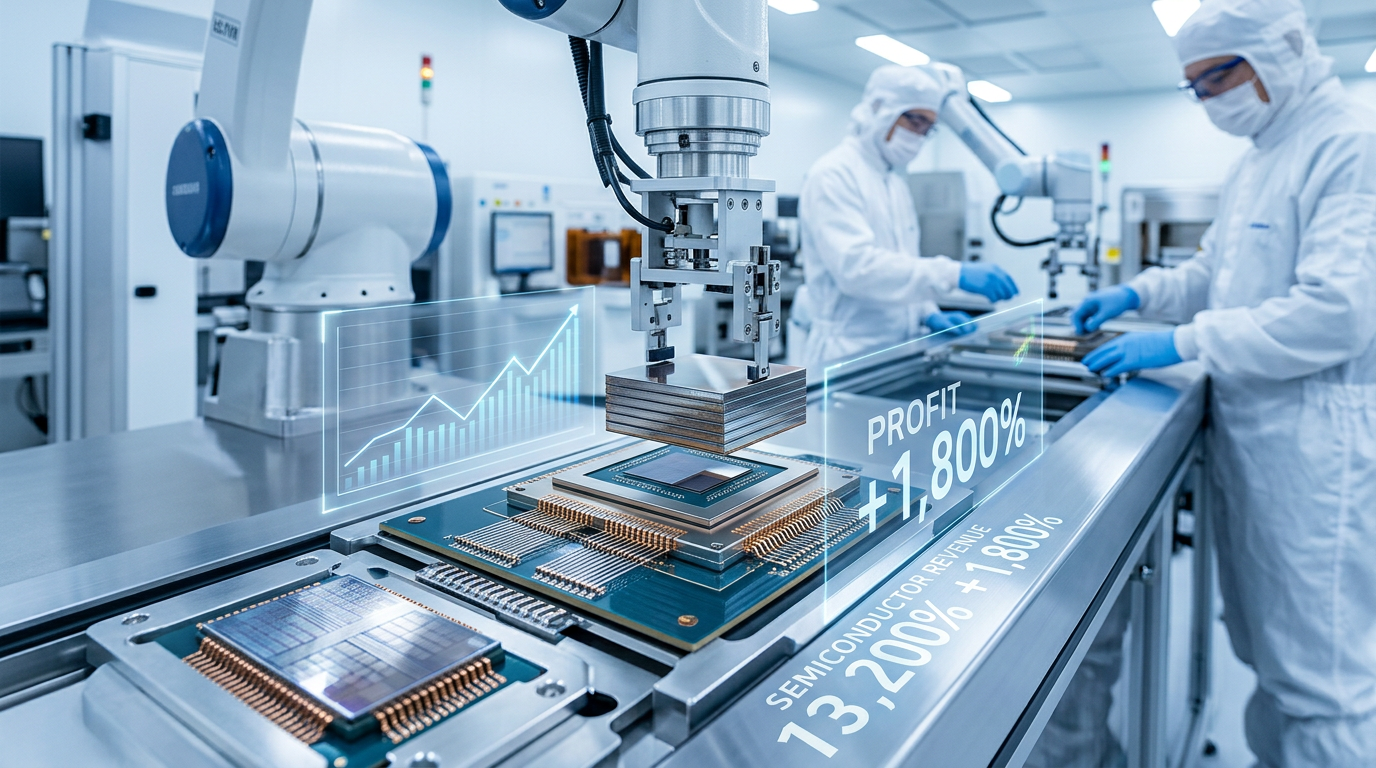
- Samsung releases Q2 preliminary results Monday, July 7. Analyst consensus puts operating profit at roughly 85.5 trillion KRW (~$55.9 billion) — an 18-fold increase versus the 4.7 trillion KRW posted in Q2 2025.
- That would be the highest quarterly operating profit ever recorded by any tech company globally, surpassing Apple and NVIDIA’s same-period figures.
- Exclude the one-time bonus provision and the number looks even bigger. A newly agreed DS division performance bonus — estimated at 19 to 25 trillion KRW — is being booked this quarter. Strip it out, and analysts say underlying profit capacity has already crossed 100 trillion KRW for the first time.
- Samsung’s full-year 2026 profit is tracking toward ~300 trillion KRW (~$200 billion). The company’s own DS division head said this year’s profit will exceed everything Samsung earned in semiconductors over the past 40 years combined.
- Q2 DRAM prices rose roughly 44% and NAND roughly 53% vs. Q1. Negotiations for a further 20%+ DRAM increase in Q3 are already underway, per analyst reports.
- SK Hynix lists on Nasdaq this Thursday (July 10) as ticker SKHY in a ~$29 billion offering — the largest ADR listing in history, eclipsing Alibaba’s 2014 debut and Saudi Aramco’s 2019 IPO.
- The full Samsung Q2 report with segment detail drops July 23. That is when HBM and NAND margin data will move U.S. proxy names like Micron.
Trump redacted 750 files while smelling Biden?
Biden’s smell hadn’t even left the Oval Office yet…
And Trump got to work immediately on the most secretive government operation since the Manhattan Project.
While the world was distracted by tariffs, Trump redacted over 750 government files.
Because Trump saw the writing on the wall: These files were about to destroy everything we love about America.
Monday morning, Samsung Electronics drops its preliminary Q2 numbers. The figure the market is expecting is not a misprint.
Consensus sits at roughly 85.5 trillion KRW — about $55.9 billion in operating profit. That is an 18-fold jump from the 4.7 trillion KRW Samsung posted in Q2 2025, and a 49.5% sequential climb from Q1’s already-record 57.2 trillion KRW. For context, Q1 alone exceeded Samsung’s total 2025 full-year result. The full-year 2026 number is now tracking toward 300 trillion KRW, and the company’s own DS division head made it explicit at an all-hands last week: this year’s profit will surpass everything Samsung generated in semiconductors over the past four decades.
One thing worth flagging: a one-time performance bonus provision for the semiconductor division — pegged somewhere between 19 and 25 trillion KRW — is being absorbed this quarter. Brokerages have been cutting estimates to account for it. But the flip side of that is also true. Strip out the provision and multiple analysts say Samsung’s underlying profit capacity already crossed 100 trillion KRW for the first time. The provision distorts the headline. The underlying business is running even hotter than the consensus suggests.
What the Market Is Pricing In — and What It Is Missing
Samsung shares jumped over 4% on Sunday’s Korean session. SK Hynix launched its U.S. roadshow the same day. Chip stocks broadly rallied. That is the surface read.
What is interesting is the price trajectory that got us here. In Q1, Samsung’s blended average selling price rose roughly 90% quarter-on-quarter for DRAM and roughly high-80s percent for NAND — confirmed on the company’s own earnings call. Then in Q2, DRAM prices rose another ~44% and NAND another ~53%, according to Reuters. Now, Q3 negotiations for a further 20%+ DRAM increase are already in motion. This is not a one-quarter event. It is a compounding price cycle that has been running for three consecutive quarters with no visible ceiling yet.
Samsung expects server memory demand to stay strong in H2 2026 as hyperscalers keep scaling AI infrastructure — and the rise of agentic AI workloads is expected to push demand further from there. Analyst consensus for Q3 operating profit is already running around 110 to 114 trillion KRW. Forward guidance from the July 23 full report matters more than whatever the headline number is tomorrow.
THE ENERGY CUBE
The “Indiana Jones of Finance” Believes He May Have Found his Next 10-Bagger.
The Second-Order Trade Nobody Is Watching
Slight tangent, but it matters. SK Hynix lists ADRs on Nasdaq this Thursday as SKHY — roughly $29 billion in size, which would make it the largest-ever initial U.S. stock sale by a foreign company, surpassing Alibaba’s $21.8 billion 2014 New York debut and Saudi Aramco’s $25.6 billion 2019 IPO. Until now, SK Hynix’s exclusive listing on the Korean exchange kept most U.S. and European investors out — Korean trading hours, won-denominated settlement, no index eligibility, no standard brokerage access. That changes Thursday.
Think about what that actually means. SK Hynix controls roughly 56% of the global HBM market by revenue. It is Nvidia’s primary HBM supplier. Its forward P/E sits around 6-7x, versus Micron’s 8-10x — not because the business is weaker, but because it has been structurally inaccessible to the deepest pools of global capital. HSBC already raised its price target to 4 million KRW, projecting a 20% valuation premium post-listing. Analysts are flagging potential Nasdaq-100 index inclusion down the road, which would trigger passive inflows from ETFs like QQQ. The listing is a valuation event, not just a fundraising event.
The part people skip: Samsung stock closed at roughly 318,000 KRW on July 6 — up 456% over the past year but still down about 15% from its all-time high. An 18-fold earnings surge, a company still trading below its peak, and a demand curve that is pulling forward 2027 orders right now. That combination does not show up often.
Bull / Base / Bear
- Bull: Q2 results beat consensus at the high end (Hana Securities projects 92 trillion KRW), HBM4 ramp accelerates, and the SK Hynix ADR debut pulls institutional capital directly into the AI memory complex. Analysts rebuild full-year models upward and memory stocks move 20-30% higher into year-end.
- Base: Results land in the 85-86 trillion KRW range. The bonus provision absorbs some of the beat. Guidance holds and the move stays intact — but does not accelerate meaningfully until Samsung’s July 23 full report drops segment-level HBM and NAND margin detail.
- Bear: The bonus provision skews the headline lower than expected, triggering profit-taking after a sharp run. Samsung is still chasing HBM market share recovery after documented yield setbacks on HBM4. It can have 50% more HBM production capacity and still be supply-constrained at the customer level if qualification timelines slip by even one quarter. Any sign of margin compression or HBM delivery delays in the July 23 call could hit names across the sector.
What to Watch
Samsung runs a two-step disclosure process. Tomorrow is the preliminary release — consolidated revenue and operating profit only, no segment breakdown. The full audited report with division-level detail comes July 23. That second read is the one that moves U.S. names like Micron, because it shows the actual HBM margin, NAND contribution, and whether the foundry business is recovering or still a drag.
Buying SpaceX? That’s a BIG mistake.
At least, that’s what one trader whose research was sought out by over 500 institutions says.
Not because SpaceX is a bad company…
But because after 23 years, he knows the biggest IPO is NEVER where the biggest money gets made. Instead, the real fortunes come from what he calls the “Aftershock.”
And SpaceX’s Aftershock promises to be the BIGGEST one yet.
The market question tomorrow is whether Samsung beats 85.5 trillion KRW. That is the wrong question to be focused on. The more important question is whether the July 23 full report forces a broad revision cycle across AI memory models — and whether that revision cycle triggers sustained multiple expansion in names that have not yet moved to reflect what the underlying demand curve is actually showing.
That revision cycle has not started yet.