Here is the question worth sitting with: if a company has already booked more revenue than it can ship, what exactly is the market still arguing about?
Vertiv Holdings (VRT) has a $15 billion backlog. That figure – confirmed in Q1 2026 filings – covers roughly 12 to 18 months of forward revenue. Management said it plainly on the April earnings call: the backlog provides visibility well into 2027. The company’s trailing twelve-month organic orders grew approximately 81% compared to the prior year period. The book-to-bill ratio in Q4 2025 was 2.9x. For every dollar of revenue shipped, Vertiv is booking nearly three more in new orders.
And yet. The stock trades at a premium, some bears are circling the valuation, and Q2 earnings on July 29 are being framed mostly as a revenue check. That framing is missing the point.
The Margin Story Is the Real Trade
Revenue growth at 30% year over year is already priced in by most of the 26 analysts covering VRT, nearly all with Strong Buy ratings. What is not fully priced is the operating leverage compression that is quietly happening inside the business.
In Q1 2026, adjusted operating margin hit 20.8%, up 430 basis points from Q1 2025. Diluted EPS jumped 136% year over year to $0.99. Free cash flow came in 147% higher. Management has now guided for a full-year adjusted operating margin target of 23.3%, with a path toward 25% margins by 2029 per some analyst models.
The arithmetic here matters. Management raised full-year 2026 guidance to $13.5 billion to $14 billion in net sales – implying roughly 30% organic growth and 51% earnings growth for the full year. If the margin trajectory holds, the EPS number for 2026 could land closer to $6.16 per share according to consensus estimates, up nearly 47% from 2025. That is the number Wall Street is underweighting.
Slight tangent, but it matters: Vertiv just opened a manufacturing facility in Johor, Malaysia on July 1. That is not a minor capex footnote. It signals the company is building geographic redundancy into its supply chain ahead of what could be a multi-year hyperscaler buildout in Asia Pacific. The timing is deliberate.
What Vertiv Actually Does – and Why That Matters Now
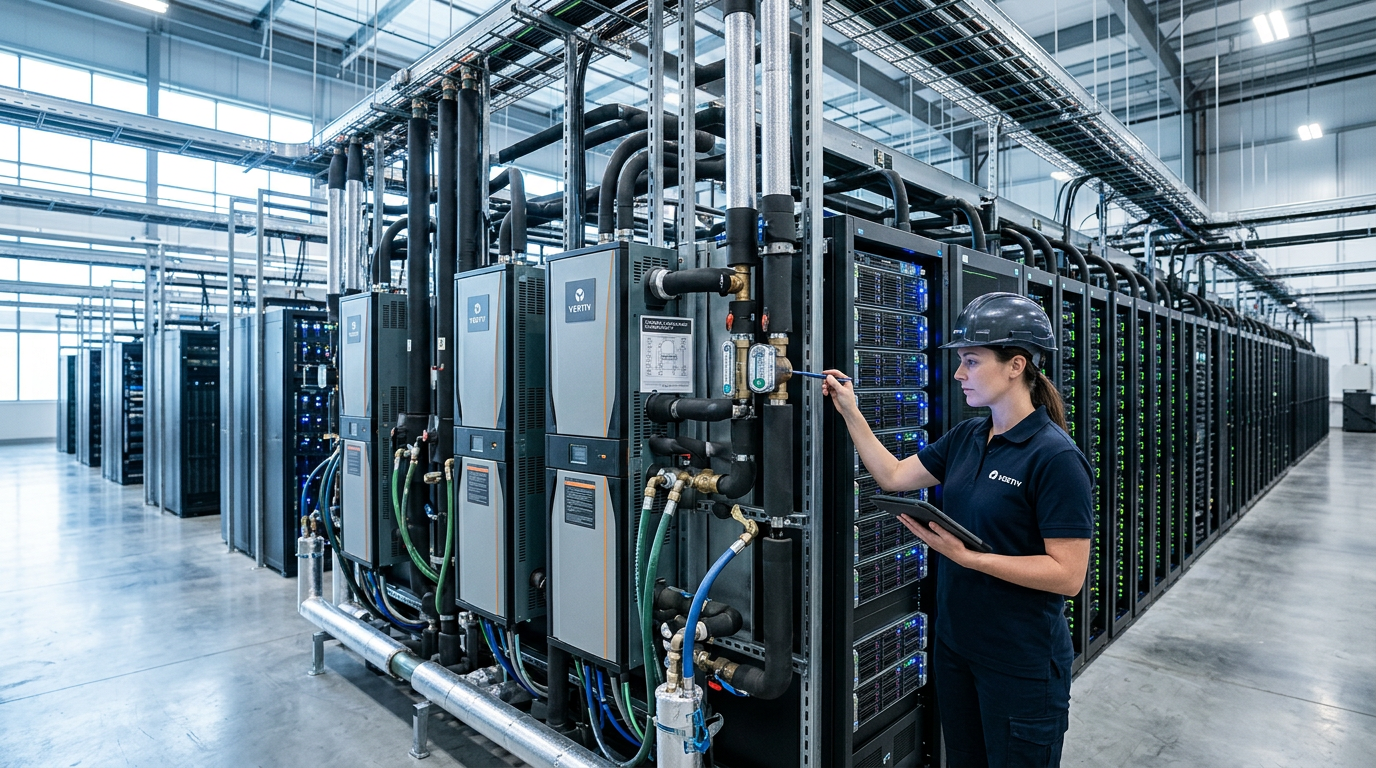
Vertiv sits between the utility grid and the server racks. Every new AI infrastructure build needs power and cooling before any GPU can run. That is the physical reality of the AI trade that gets lost when conversations focus on chip stocks and software multiples.
The company has struck partnerships with Nvidia and Intel to design liquid-cooling solutions for their AI chip systems, including Nvidia’s latest Vera Rubin platform. More recently, Vertiv expanded its collaboration with Nvidia to co-develop an 800-volt DC power architecture and launched a production-grade digital twin product integrated with Nvidia Omniverse DSX. That digital twin capability repositions Vertiv from hardware vendor to engineering partner across the full AI data center lifecycle.
Roughly 75% of Vertiv’s revenue comes from data center customers. The Americas region led Q1 organic sales growth at 44%, driven by hyperscale and colocation demand. This is not a company scraping for orders. The orders are arriving faster than production can convert them.
The Acquisition Cadence Is Telling a Story
Most investors are not tracking this closely enough. In March 2026, Vertiv announced the acquisition of ThermoKey, an Italian heat-rejection systems manufacturer. The deal directly expands Vertiv’s liquid cooling capabilities across North America and EMEA, regions where hyperscaler capital expenditures are accelerating. Completed in June. Then in April, Vertiv acquired Strategic Thermal Labs, a specialist in cold-plate design and server-side liquid cooling. The acquisition extended what the company calls its “thermal chain strategy.”
Management has outlined an M&A pipeline targeting $750 million to $1 billion in further bolt-on acquisitions focused on AI infrastructure. The pattern is clear: Vertiv is systematically closing every gap in the liquid cooling stack before competition can establish a foothold.
Liquid cooling matters because AI chips from Nvidia, AMD, and others generate heat densities that traditional air-based systems cannot handle at scale. The transition from air to liquid is happening faster than most data center operators planned for. Vertiv is the company that benefits most from that acceleration.
The Bull Case and the Bear Case
The bull case rests on backlog conversion and margin expansion. CEO Giordano Albertazzi said the backlog, now above $15 billion, provides revenue visibility well into 2027. If that converts at the guided margin levels, the earnings power through 2027 is significantly underrepresented in current consensus models. Bernstein initiated coverage with an Outperform rating and a $416 price target, calling Vertiv “arguably the only pure-play with scale” in this infrastructure category.
The bear case is simpler. If AI capex expectations cool or hyperscaler earnings disappoint, VRT shares will feel that pressure faster than less-cyclical industrials. The stock has a 5-year beta of 2.04 – it moves hard in both directions. Customer concentration is also real. A handful of hyperscalers represent an outsize portion of orders, and any shift in their buildout timelines ripples directly into Vertiv’s backlog conversion schedule. There is also the emerging risk that hyperscalers start bringing more thermal management in-house over time.
What July 29 Is Actually Testing
The Q2 number that matters most is not the revenue line. It is whether the company confirms its full-year adjusted operating margin guidance of 23.3%. VRT’s Q2 guidance calls for net sales of $3.25 billion to $3.45 billion. A beat on that range with held or raised margin guidance would likely push the stock back toward its $380 high.
The liquidity picture is also worth noting. After receiving investment-grade ratings from Moody’s and S&P in February 2026, Vertiv completed a $2.1 billion senior unsecured notes issuance and put in place a new $2.5 billion revolving credit facility, while net leverage stayed at approximately 0.2x at quarter end. The balance sheet is not a concern. The question is execution speed against a backlog that keeps growing faster than the company can ship.
The AI infrastructure trade has been dominated by semiconductor and cloud names. What Vertiv represents is something different – a company with locked-in forward demand, widening margins, and a strategic position that becomes harder to displace with every new liquid-cooling partnership signed. July 29 is not just an earnings date. It is the clearest read yet on whether the physical infrastructure layer of the AI trade is delivering on its numbers.
This article is for informational purposes only and does not constitute investment advice or a recommendation to buy or sell any security. All data referenced is sourced from public filings and analyst reports. Past performance is not indicative of future results. Investing in equities involves risk, including the possible loss of principal.