
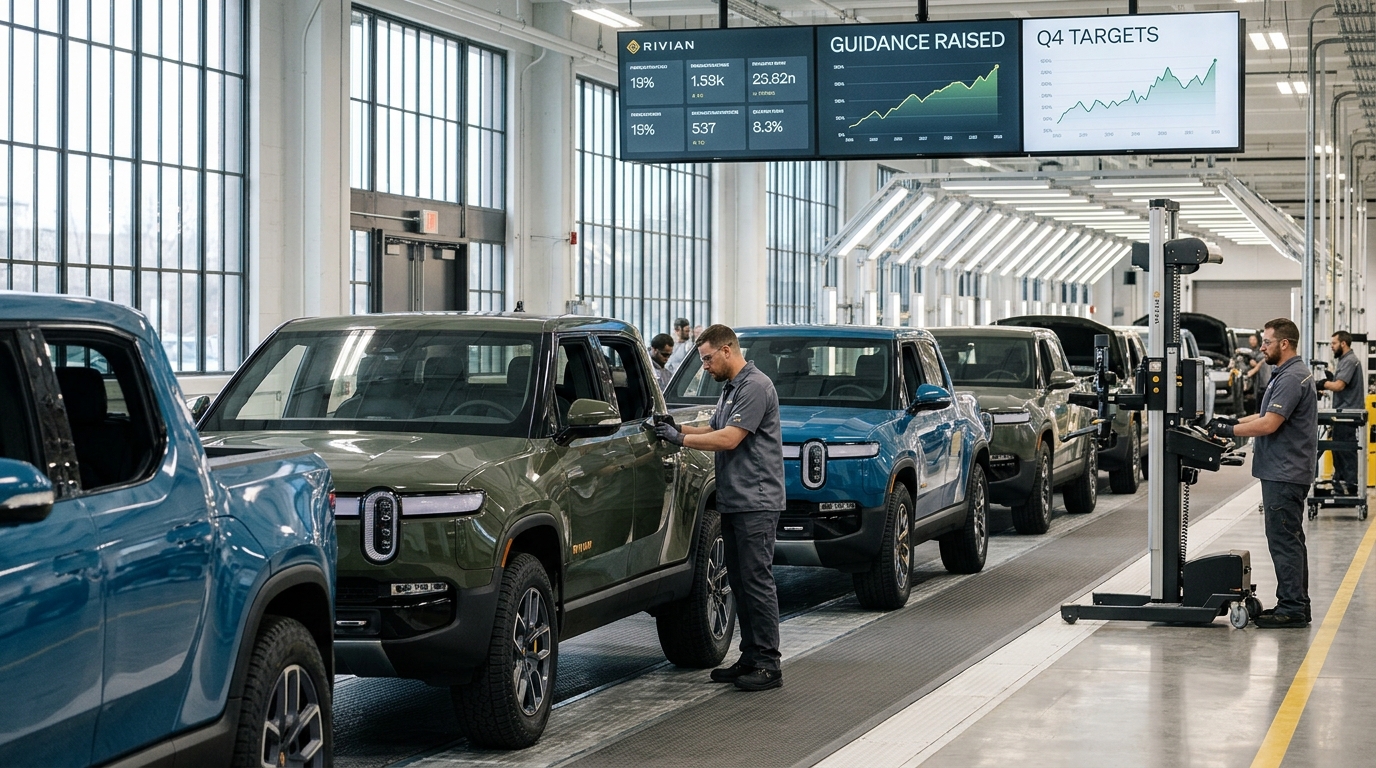
There was a moment Thursday evening that said more about Rivian than any single data point. While the broader market spent the day digesting guidance cuts and cautious outlooks from company after company, Rivian walked up to the podium and raised. Full-year delivery guidance moved to 67,000–70,000 vehicles, up from 65,000–70,000 just a quarter ago. Shares had hit a new 52-week low of $11.38 earlier in the session before the company flipped the script entirely.
Why This Stock Now
Rivian reported stronger-than-expected third-quarter results on October 29, driving its stock up about 7% in after-hours trading. That reaction is meaningful in context: the stock was still down 5.1% over the prior week, 12.1% over two weeks, and 22.4% over the past month heading into the results. A relief rally alone does not make a compelling case. What does is the operational substance underneath it.
The Business
Revenue rose 38% year-over-year to $2.155 billion, deliveries climbed 46%, and the R2 became Rivian’s best-selling vehicle by volume, outselling both the R1 and the EDV in the third quarter. That last point deserves to stand on its own. The R2 only began reaching customers in June. Within one full quarter of ramp, it became Rivian’s best-selling model.
Gross profit reached $176 million during the third quarter, up from $24 million a year earlier. Adjusted EBITDA loss was $435 million, a $167 million improvement from the same period last year. The trajectory is not yet profitable, but the direction is unambiguous.
Why Wall Street Is Paying Attention
Management said R2 is expected to represent the majority of delivery volume in the fourth quarter. A second R2 production shift has started in Normal, Illinois, with the manufacturing run rate expected to rise over coming quarters. That combination, rising shift utilization and an already dominant internal sales mix, is what investors had been waiting to see confirmed.
The funding picture also shifted materially this year. In an SEC filing, Rivian said the committed $1.0 billion, 10-year term loan facility from Volkswagen Group was funded on October 7, 2026. The facility carries a 6.03% per annum fixed interest rate and is secured by Rivian’s 50% equity interest in the joint venture. That funding is part of a partnership that Volkswagen has described as worth up to $5.8 billion. Separately, Uber plans to invest up to $1.25 billion in Rivian through 2031, subject to the achievement of certain autonomy milestones by specific dates. The company ended Q3 with approximately $5.5 billion in cash, cash equivalents and short-term investments.
What’s Driving the Opportunity
CEO RJ Scaringe has said Rivian will reach profitability this year on a per-unit production basis with the R2, a smaller and less expensive sibling to its current luxury R1S SUV. Management expects R2 to represent most Q4 deliveries and said its target is to exit Q4 with positive automotive gross profit. Exiting Q4 with a positive per-unit margin line would be the inflection point the market has been discounting for two years.
The longer-range opportunity is larger still. Uber plans to invest up to $1.25 billion in Rivian as part of a deal that calls for deploying up to 50,000 fully autonomous robotaxis through 2031, subject to milestone conditions. Software and services revenue, much of it tied to the Volkswagen joint venture, reached $605 million in Q3, up 45% year-over-year, according to the company’s earnings release. That is not a vehicle company in the traditional sense. It is becoming a platform.
What Could Go Wrong
The Georgia plant is where enthusiasm runs into arithmetic. Rivian has said 2026 capex guidance came down primarily due to a shift in timing of certain capital spend. In short, the bill is deferred, not reduced.
Automotive gross profit remained negative, free cash flow worsened year over year, and the R2 ramp is not yet at normalized production economics. Continued cash consumption and a July stock sale also show that dilution remains a relevant risk while Rivian funds growth before company-wide profitability. Any investor buying here is betting that R2 volumes and the Volkswagen software revenue stream can outpace those capital demands fast enough to avoid another equity raise at a depressed share price.
Deferred capital spend is a pattern across the EV industry, not a Rivian-specific choice. Ford’s idle battery plants illustrate how EV manufacturers are restructuring capital timelines to delay losses while preserving optionality.
The Bottom Line
Rivian’s Q3 report is the clearest evidence yet that the R2 transition is working. Losses narrowed faster than expected, and full-year guidance went up at exactly the moment when most companies were pulling it lower. Management raised full-year delivery guidance to 67,000–70,000 units, improved the adjusted EBITDA outlook by $100 million at the midpoint, and lowered capex guidance by $300 million at the midpoint. That is a three-metric sweep in the right direction.
The stock’s 22% monthly decline before Thursday created a low entry point against fundamentals that are now visibly improving. The Georgia plant construction and persistent cash burn are real risks, and neither disappears with a strong quarter. But for investors who want exposure to the one EV name currently accelerating while others decelerate, Rivian is the most compelling case available today.