
October 4, 2026
Bonus Content: Nike Fell 9% After Earnings. Where the Turnaround Stands
Most traders live in absolute terror of the market pulling a sudden U-turn right after they enter a position…
They buy a breakout, watch it start moving, and then freeze as price completely reverses and wipes out their account…
It’s an exhausting way to trade, but it happens because standard trading forces you to guess direction…
What if a trade could go completely backwards, and still give you a shot at $500 in your pocket before lunch?
Look at what happened back on Tuesday, August 11th…
There were no major headlines moving the market and no surprise economic announcements…

But, according to our research, right around 10:00 AM, a morning setup triggered a clean breakout to the upside…
Everything looked normal until price suddenly reversed and slammed right back inside the morning range…
For traditional traders, that sudden reversal was a guaranteed loss…
Yet anyone who placed this single morning trade would have still walked away with a $520 payout before lunch…
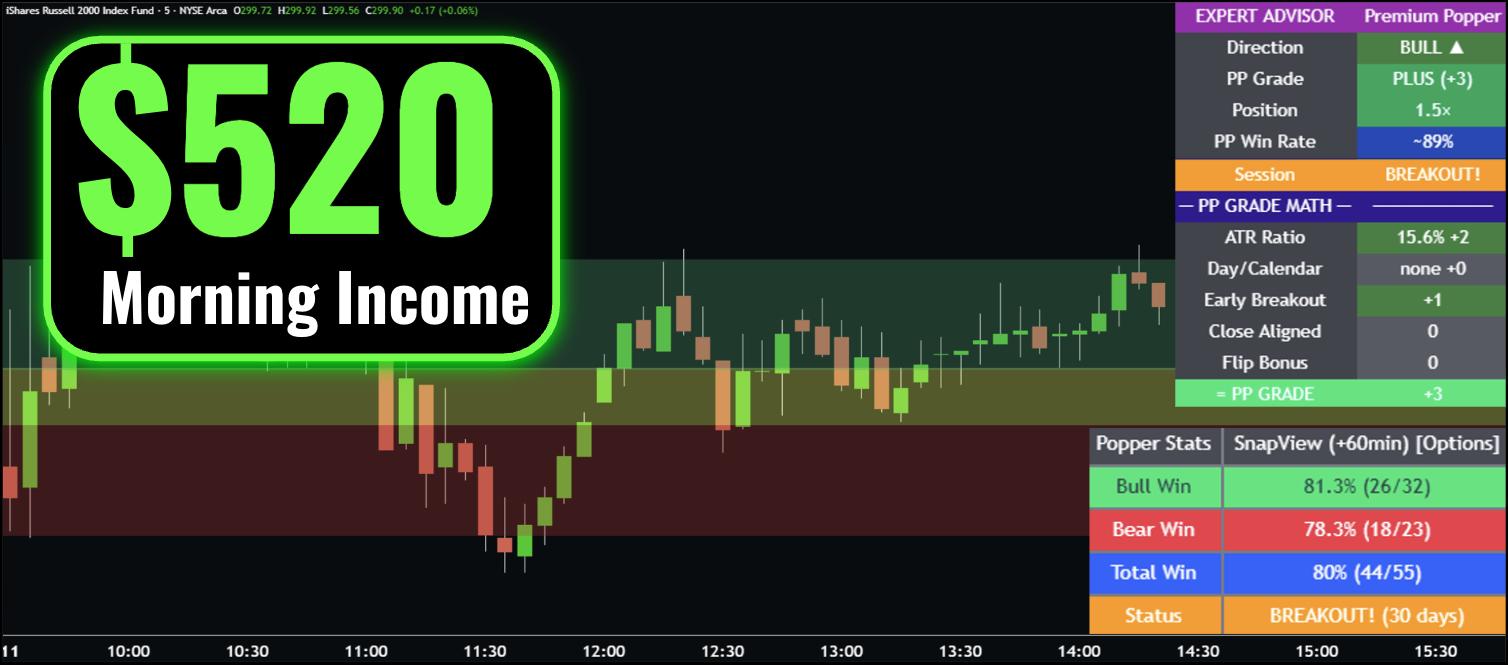
The very next day, August 12th, it would have happened again…
A downside trade was looking great by 11:30 AM, but then price turned on a dime, reversed back into the opening range, and stayed there all afternoon…
The breakout failed completely… yet it still would have resulted in another $500 payday on a simple $1,000 starting stake…
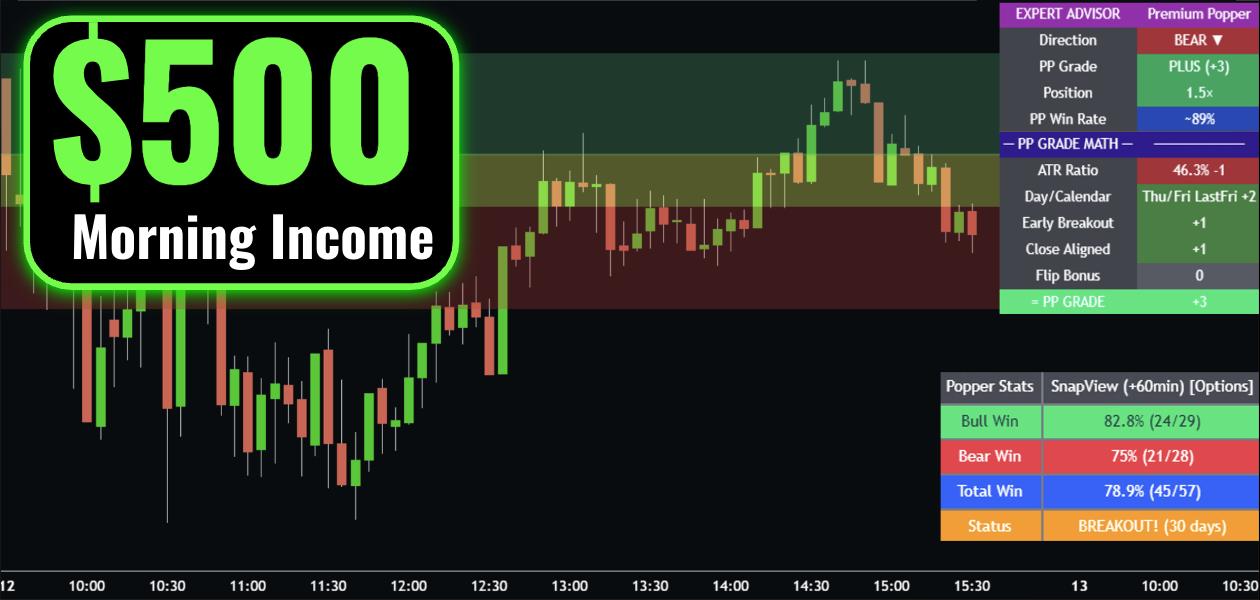
Of course, there would have been smaller gains and some that did not work out, but…
How is it possible to profit when a breakout completely fails?
It all comes down to what happens between 9:30 AM and 9:50 AM every single morning…
During those first 20 minutes, institutional buyers and sellers clash to settle block orders, dumping nearly 25% of the entire day’s volume into the market…
That surge in volume creates the exact price levels where buyers and sellers failed…
Instead of guessing where stocks will go before the bell, waiting until 9:50 AM lets you react to where money is actually flowing…
When structured correctly, there are three distinct ways to win:
If the market moves in your direction, you win… If the market stays completely flat, you win.
And even if the market moves slightly against you, you can still win.
While I cannot make any guarantees in the market…
Recently, I sat down live for a private presentation with a former money manager to pull back the curtain on this 9:50 AM phenomenon and show how these setups work step-by-step…
Access to this is restricted, but for the next couple of hours…
You can follow this link to watch and access the full presentation before access closes.
See you there,
Silas Peters
Nike Fell 9% After Earnings. Where the Turnaround Stands

Nike fell roughly 9% in after-hours trading on October 1, 2026 after reporting fiscal Q1 2027 results that exposed how far the turnaround still has to go. The stock traded around $32 in after-hours dealing and entered October 2 near a 52-week low of $31.97, down from a 52-week high of $76.97. At $32, this is a company priced for ongoing distress, not recovery.
Revenue of $11.2 billion was down 5% on a currency-neutral basis and missed the Street’s estimate. Earnings per share came in at $0.48, which beat consensus but did not soften the damage from the full-year forecast. Fiscal 2027 adjusted EPS guidance of $1.15 to $1.35 was well below the prior consensus. That gap is why analysts spent the morning of October 2 cutting targets.
The China Problem Is Not a Rounding Error
Greater China revenue fell 26% on a currency-neutral basis to $1.18 billion. That is not a clean-up quarter; it is accelerating deterioration. Nike’s digital distribution in China is being reset, and management is emphasizing more local product creation and marketplace changes that will take time. The company is rebuilding an entire market strategy with no near-term volume to show for it.
Converse fell 28% currency-neutral. Jordan Brand fell by mid-teens. Nike reduced Dunk revenue by nearly 50%, creating an approximately $200 million headwind in Sportswear. North America was the one bright spot, growing 2% on a currency-neutral basis. That is real. It is just not large enough to offset what is happening in Sportswear and China.
Why This Might Be the Time to Look
Every analyst covering a broken consumer franchise eventually faces the same question: is the bad news already in the price? At $32 and a 52-week range of $31.97 to $76.97, Nike is priced for continued failure. The fiscal 2027 full-year EPS midpoint of $1.25 puts the stock at roughly 25 times depressed earnings, which is not cheap on the surface. But the Pace restructuring program is cutting costs, selling and administrative expense fell 3% in the quarter, and gross margin improved 60 basis points to 42.8% on lower warehousing and logistics costs.
Management expects EBIT to decline faster than revenue in fiscal 2027, meaning margin pressure is not over. The company said the fiscal 2027 adjusted EPS range excludes approximately $0.15 of restructuring expenses related to Pace. An investor buying here is betting on a 2028 earnings rebound, not fiscal 2027 stabilization.
What Could Go Wrong
The risk is that China takes longer than expected, wholesale partners pull back further, and the Jordan Brand reset runs into calendar 2028. Bank of America downgraded the stock to underperform in late September, arguing risks are rising. Morgan Stanley carries a $27 price target and an underweight rating. Those are not outlier views; they reflect a real possibility that the floor has not been reached.
A November investor day is the next potential reset. If CEO Elliott Hill fails to offer a credible timeline for China recovery and Jordan Brand stabilization, the stock faces another leg down.
The Bottom Line
Nike is not the most compelling stock available today. China is genuinely broken, the outlook is worse than feared, and the restructuring will suppress profitability for multiple quarters. But at $32, with North America growing and gross margins improving, the stock is beginning to reflect a realistic bear case. Investors who can tolerate a 12-to-18-month holding period through the inventory cleanup should watch the November investor day closely. That is the event that separates a trough from a trap.