
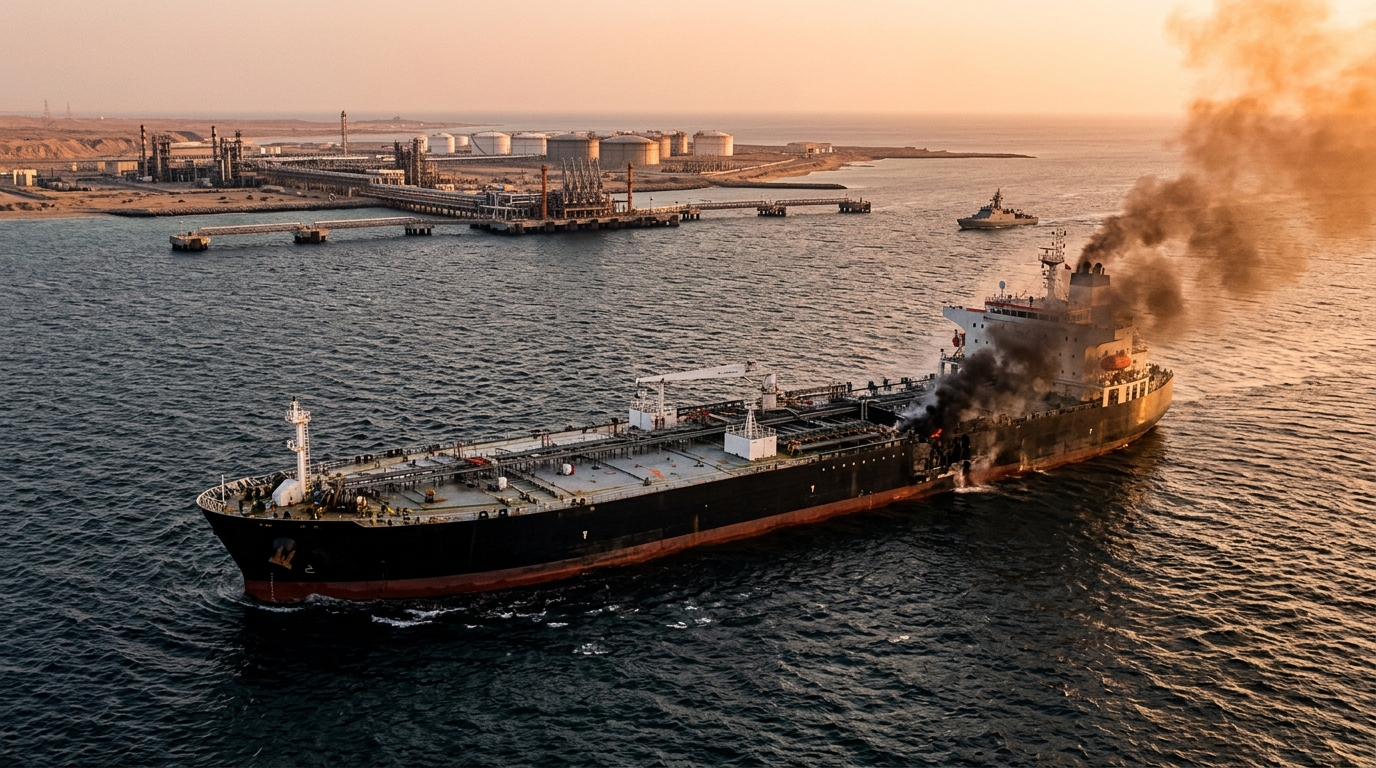
Saturday’s strikes changed the character of this conflict, at least for oil traders. The US military said it hit three Iranian oil tankers, including one near Kharg Island, the country’s main oil terminal, after Iran launched ballistic missiles toward two US Navy warships. CENTCOM confirmed its strikes disabled one carrier off the coast of Kharg Island and another off Jask, and destroyed a third in the Gulf of Oman. The three vessels were identified as the M/T Downy, M/T Stark 1, and M/T Kylo.
Iran is OPEC’s third-largest producer and exported 90% of its crude via Kharg Island before the war, with flows already disrupted by a US blockade on Iranian oil exports that began in mid-April. Now the US is hitting the tankers themselves. CENTCOM said the ships “are part of a multibillion-dollar shadow network that funds the IRGC and its regional proxies.” CENTCOM commander Admiral Brad Cooper was blunter still, warning the IRGC that a missile attack on two US ships would cost them three of their own.
The supply side has no offset. OPEC+ is set to keep its oil output policy unchanged for October at a Sunday meeting, per two people familiar with the discussions who spoke to Reuters, as the producer group needs to agree new quotas before deciding its next output steps. Actual production remains well below the group’s targets amid the war and disruptions to regional oil flows, meaning previously announced increases have had a more limited effect on physical supply than the headline quotas suggest. The group cannot paper over a geopolitical supply shock it did not create.
Brent and WTI: Levels for Tuesday’s Open
Brent traded around $96 a barrel Friday and was up 7.6% for the week, its strongest weekly performance since mid-July, as tensions between the US and Iran continued to drive market sentiment. Brent’s Friday settlement came in at $96.28 per barrel. Both figures precede Saturday’s strikes, which hit after US market close with Monday out for Labor Day.
Tuesday’s gap open is the first decision traders face. A spike through $100 is the clearest scenario: Kharg Island is where roughly 90% of pre-war Iranian crude loaded onto tankers, and targeting vessels in that anchorage is a step beyond prior military activity in the region. Resistance sits near the April 30 intraday high of $120.88. For those already long, a reasonable stop on a pullback would be just below the pre-strike Friday close, around $94.50. A failure to hold $93 on a gap-fill would weaken the case for immediate follow-through.
XLE and XOP: The Long Side
During the most recent 30-day period, XLE advanced approximately 9%, reflecting renewed geopolitical tensions and a partial recovery in crude oil prices after a midyear pullback. XLE’s top two positions are ExxonMobil at roughly 19.8% of assets and Chevron at 15.1%. Both majors benefit directly from higher realized crude prices.
XOP, the exploration and production fund, carries more beta to spot oil than XLE’s integrated-major weighting. OXY, trading near $60 on Friday, reported Q2 2026 adjusted EPS of $2.40, beating estimates by 29%, with free cash flow surging to $3.0B and debt falling to $11.8B, its lowest since Q2 2019. That balance sheet gives OXY room to absorb volatility. The thesis on both funds: stay long while Brent holds above $92. A sustained close below that level, particularly on a ceasefire rumor or surprise OPEC+ reversal, is the exit signal.
Airlines: The Other Side of This Trade
Fuel is the second-largest cost for most carriers, typically accounting for about a quarter of operating expenses. Jefferies has said that each 5% change in fuel price estimates for 2026 translates to a 5% to 10% impact on Delta’s and United Airlines’ earnings per share. American Airlines declined as much as 6% and United fell as much as 7% during the last major oil spike earlier in the year. A fresh run toward $100 Brent resets that math immediately.
DAL, UAL, and AAL are the short candidates on a confirmed gap-up in crude Tuesday morning. The trade is not a structural bet against airlines; it is a hedge against the energy long. If Brent reverses sharply on any diplomatic development, close the airline short before the energy long, since carriers will rally faster on de-escalation than integrateds will fall.
Risk Dashboard
The primary risk to the energy long is a diplomatic pivot. Any credible ceasefire signal between Washington and Tehran would reverse the move quickly, as it did in March when oil slid about 2% in a single session as markets reacted to reports of a US plan aimed at ending the war. The secondary risk is escalation beyond oil markets into broader risk-off: equity futures, credit spreads, and the dollar all matter Tuesday morning. Watch the VIX at the open. A spike above 25 alongside an oil gap suggests traders are selling risk broadly, not rotating into energy, and that changes position sizing. Watch CENTCOM statements and any Iranian government response Sunday night into Monday.