
September 1, 2026
Three education companies are winning where it matters. One stands out.
The U.S. construction industry will need to attract 349,000 net new workers in 2026, according to the Associated Builders and Contractors. By 2030, the broader skilled-trades gap is often cited at roughly 1.4 million. Data centers, EV infrastructure, and grid modernization are pulling in one direction; a retiring workforce is walking out the other. That collision is not just a labor problem. It is an enrollment catalyst for a handful of publicly traded education companies right now.
The Three Candidates
Lincoln Educational Services (LINC), Grand Canyon Education (LOPE), and Stride (LRN) each posted Q2 2026 results over the past month. All three are profitable. All three are growing. But they are growing in different ways, at different speeds, with very different risk profiles.
Stride delivered $2.518 billion in fiscal 2026 revenue, up 4.7% year over year. Career Learning was the engine, with enrollments climbing to 109,700. But general education enrollment declined, gross margins slipped 140 basis points to 37.8%, and a CEO succession announcement rattled shares. Management has discussed fiscal 2027 assumptions, but investors did not get a clean, traditional guidepost set that would remove uncertainty. That is not a disqualifier, but it is a reason to wait.
In at 9:35 AM. Out by 10.
I call it the “Opening Bell Breakout.” It’s the same setup I used to catch moves like 113% on GOOGL and 240% on META. I trade one simple 15-minute window each morning – and I’m usually done by 10 AM.
Grand Canyon Education is the most consistent of the three. Q2 2026 service revenue came in at $264 million, up 6.7% year over year, driven by a 7.6% rise in university partner enrollments to 126,231. Operating income grew 12.3% to $58.2 million, and operating margin hit 22%. Full-year guidance calls for $1.1653 to $1.1723 billion in service revenue and diluted EPS of $9.93 to $10.07. It is a clean, well-run business. The problem is that 47 hybrid sites are approaching capacity limits at a meaningful number of locations, and management has flagged that growth can naturally moderate as more locations fill up. The ceiling is visible.
Why This Stock Now
Lincoln Educational is the one worth owning today.
Q2 2026 revenue hit $142.6 million, up 22.4% year over year. Adjusted EBITDA increased 42.4% in Q2. Average student population rose 14.5% to 18,343 in Q2. CEO Scott Shaw reiterated full-year 2026 guidance of $590 to $600 million in revenue and $23 to $26 million in net income, supported by Q3 trends he described as tracking.
Most Traders Miss This “News Signal”
News happens every day – but only a few traders know how to turn that noise into profit.
Tim Sykes is giving you the edge: A news-based trading system + cheat sheet to help you find trades triggered by the headlines.
Zero fluff. 100% actionable. Totally free.
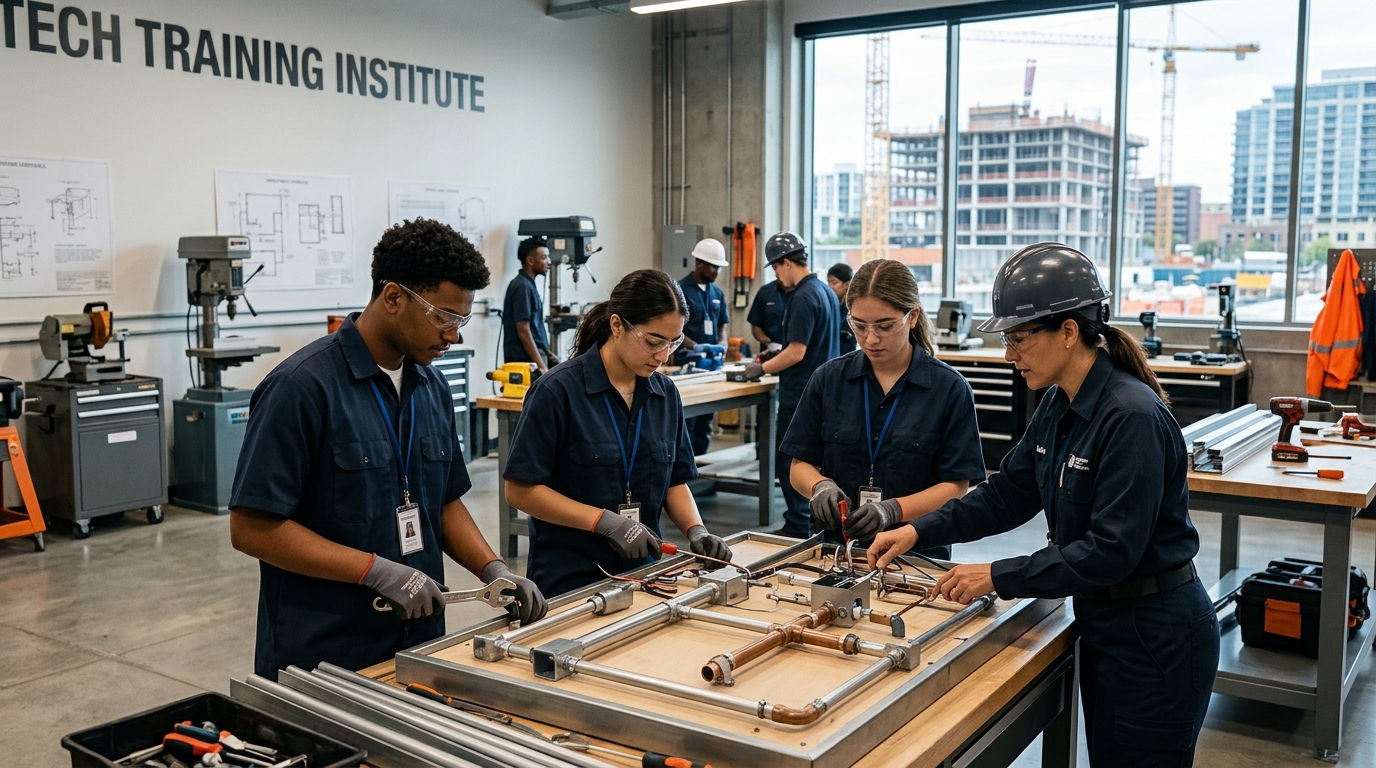
The business case connects directly to the macro. Lincoln trains electricians, HVAC technicians, automotive technicians, and healthcare workers, the exact trades facing the sharpest shortfalls. The company has entered into leases for three new campuses in New York, Texas, and Maryland, completed the acquisition of its Melrose Park, Illinois property in July, and announced a Tempe, Arizona location this month. Each new campus is targeted to generate $25 to $30 million in revenue and $7 to $10 million in EBITDA by year four. That is a replicable model running at scale.
What Wall Street Is Doing
Barrington lowered its price target to $50 from $56 following Q2, maintaining Outperform. Lake Street trimmed its target to $50 from $55 following Q2, but kept its rating. The stock has returned roughly 92% over the past year, and Simply Wall St pegs fair value near $64, well above the recent trading range. That gap is the opportunity, but it requires a view on execution.
The $16 Trillion Rare Earth Discovery
The Guardian calls it “the beginning of the biggest gold rush in history”… and one stock under $5 owns exclusive rights to harvest these rare earths.
Elon Musk and his companies need these minerals before a January 1 Pentagon deadline.
What Could Go Wrong
Lincoln is spending heavily. Capital expenditures are now guided to $95 to $100 million in 2026, and the credit facility was expanded to $125 million in April. Net margins are thin: about 1.4% in Q2. If new campuses underperform utilization targets, operating leverage reverses quickly. For-profit education also remains a regulatory target, and any shift in federal student aid rules could hit enrollment economics directly.
The Bottom Line
LOPE is the safer, lower-growth choice. LRN has the scale but needs a new CEO to prove direction. Lincoln sits at the intersection of a structural workforce crisis and an accelerating campus expansion. The trades shortage is not fading. The company is adding capacity into a market that cannot fill jobs fast enough. Three consecutive years of double-digit quarterly revenue growth says the demand is real. The question is whether margins can follow enrollment at the new campuses. That is a risk worth taking at current levels.