
Markets don’t need a story about transformation. They need proof that the transformation math is working. Baidu delivered the former again Tuesday. The latter remains unresolved.
Baidu shares slid in U.S. premarket trading after the Chinese search and AI giant reported second-quarter earnings and revenue that both missed analyst expectations. The company posted EPS of RMB 7.22, against a consensus of RMB 9.84, while revenue came in at RMB 31.33 billion, down 4% year-over-year and below the RMB 31.95 billion estimate. A 19% decline in online marketing revenue and broader weakness offset AI growth, causing revenue and earnings to miss analyst estimates for a fifth straight quarter. Five consecutive misses is not a bad quarter. It is a structural problem requiring a structural answer.
The Data
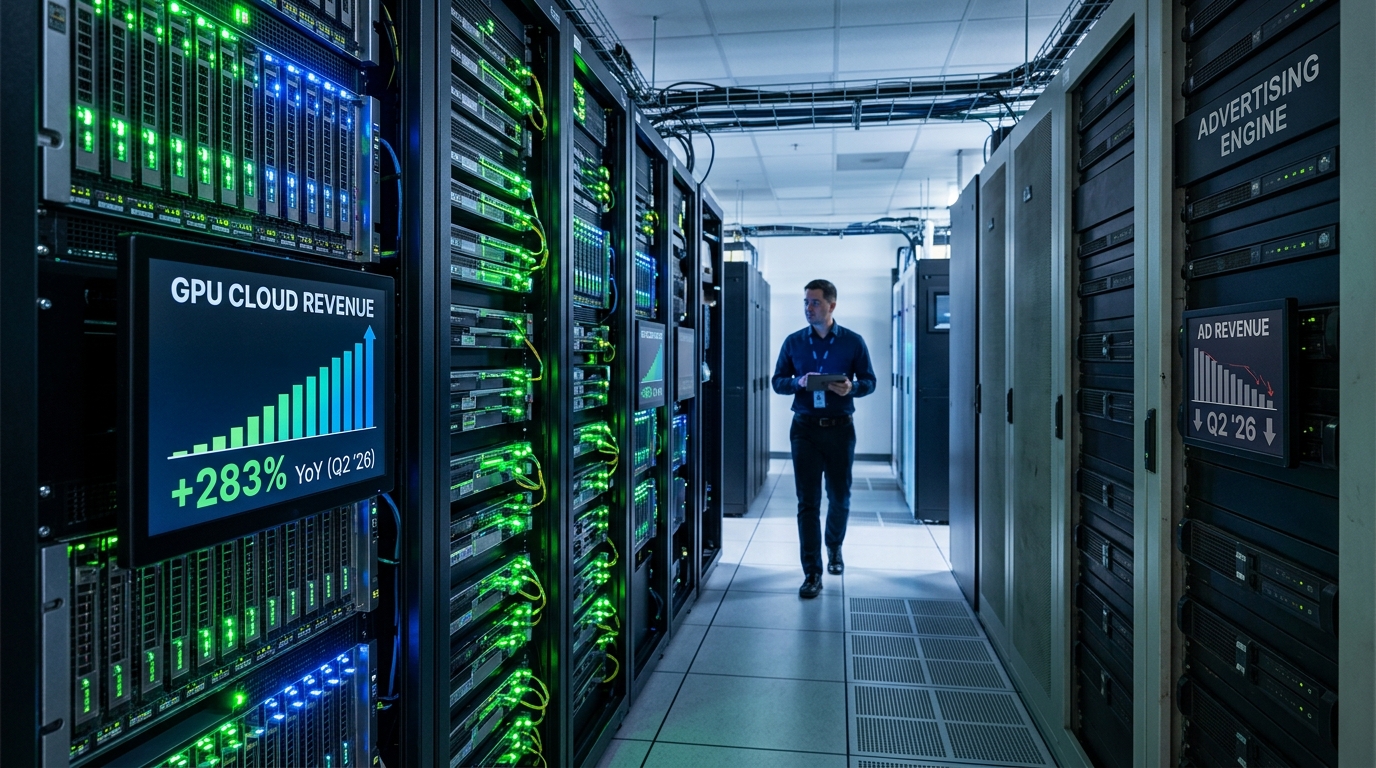
The online marketing services segment reported total revenue of RMB 13.1 billion for the quarter ended June, down 19% from a year ago. A prolonged downturn in China’s property sector and weak consumer spending have led businesses to cut marketing budgets, weighing on advertising demand and pressuring Baidu’s online marketing business. That is the ceiling on any recovery thesis anchored to legacy Baidu. The ad engine is not recovering. It is decelerating.
On the other side of the ledger, the numbers genuinely impress. AI Cloud Infrastructure revenue reached RMB 7.3 billion in Q2, up 50% year-over-year. Within that segment, GPU Cloud revenue increased 283% year-over-year, further accelerating from 184% growth in the prior quarter. Core AI-powered business revenue rose 25% to RMB 12.5 billion. Adjusted operating income came in at RMB 3.8 billion, with an adjusted operating margin of 12%, while adjusted EBITDA was RMB 6.2 billion on a 20% margin.
AI Applications revenue was RMB 2.5 billion, up 3% year-over-year. Three percent. That is the application monetization layer, and it is barely moving. GPU Cloud compounds at 283%. The products built on top of that infrastructure compound at 3%. That gap matters more than anything else in the filing.
Strategic Interpretation
This is not about one bad quarter. It is about the arithmetic of a company running two businesses simultaneously: one that compounds fast off a small base, and one that bleeds slowly off a large one. The problem is arithmetic, not ambition. The ad engine the company must eventually replace is many times larger and shrinking. Baidu is running a race against itself: the new businesses are compounding fast off a tiny base while the old one bleeds slowly off a huge one.
Revenue from AI-related operations, spanning cloud, applications, and marketing services, jumped 25% year-on-year to RMB 12.5 billion, but that total still falls short of covering the RMB 13.1 billion in online marketing revenue that shrank by nearly a fifth in a single quarter. The crossover point, where AI-powered revenue definitively carries total revenue higher, has not arrived. Q2 shows it may be closer than the headline suggests, but not close enough to move the stock today.
Baidu posted positive operating cash flow for the fourth consecutive quarter, which is a signal the pivot is not destroying the balance sheet. But BofA analyst Miranda Zhuang maintained her Buy rating while reducing her price objective from $180 to $165, simultaneously lowering core adjusted operating profit projections for 2026 through 2028 by 3% to 8%, attributing the change to declining advertising revenue and elevated AI infrastructure spending.
Sector Implications
Baidu’s Q2 is a case study in the China AI divergence. GPU demand is real: 283% GPU Cloud growth is not a rounding error, and domestic AI chips are catching up with global products in inference scenarios, with advantages becoming increasingly relevant as inference workloads continue to grow. That has long-cycle implications for how Chinese cloud providers position against U.S. hyperscalers operating under export restrictions.
Apollo Go adds a second dimension worth tracking separately from the cloud numbers. Apollo Go delivered 3.2 million fully driverless rides in Q1 2026, sustaining triple-digit growth in total rides year-over-year. Global expansion through partnerships with Uber and Lyft opens new revenue streams and markets for the mature Apollo Go platform. Those deployments, in Dubai and planned across Europe, are pre-commercial scale. They are not yet in the revenue line. When they are, the mix math changes meaningfully.
Options Market Analysis
Ahead of the earnings report, the August 104 straddle was priced for a move of 7.5%, with a call/put ratio of 1.3 calls to 1 put, with notable flow targeting August 130 calls. The straddle pricing proved prescient directionally. Shares were roughly 7.2% lower in premarket trading Tuesday, landing squarely inside the expected move but to the downside. The call concentration in August 130 strikes implies a cohort of traders was positioned for an upside beat scenario that did not materialize.
With IV elevated post-earnings, premium sellers now have a structural advantage. The near-term vol crush that typically follows an earnings event makes buying outright options costly. The more relevant question is whether the realized move exhausts near-term selling pressure or opens a drift lower as institutional holders reassess the fifth consecutive miss.
Based on forward projections, BIDU trades at 14x earnings, with an EV/EBITDA multiple of 3.3x. Intrinsic value estimates range between $107.50 and $132.31, suggesting high growth is not required for fair value at current prices. That range gives options traders a defined band to work within.
Structured Trade Framework
Bull case. For traders who believe the GPU Cloud acceleration at 283% is durable and that the advertising trough is within one or two quarters of bottoming, a defined-risk structure that targets the $107 to $115 range over a 60-to-90 day horizon may be appropriate. A bull call spread, long the $105 strike and short the $115 strike in October expiration, limits premium outlay while capping upside to the range where analyst fair value estimates cluster. Risk is the net debit paid.
Bear case. If you believe the fifth consecutive miss reflects structural deterioration rather than a timing problem, and that advertising declines accelerate into Q3, a bear put spread using October $100 and $90 strikes defines risk to the debit while targeting the lower end of pre-earnings support. Shares entered earnings at approximately $103.67, already down 28.3% year-to-date and 37% below the 52-week peak of $165.30. The downside case carries tail risk from geopolitical factors as well. The U.S. Department of Defense designation of Baidu as a Chinese military-aligned entity continues to present geopolitical challenges for the company.
Neutral case. Given elevated post-earnings IV that has likely not fully crushed yet, a short iron condor positioned between $95 and $120 for September expiration collects premium if BIDU stabilizes and mean-reverts toward the $100 to $105 range. The defined-risk structure limits loss to the width of either spread minus the net credit received. This template suits traders who believe the reaction is complete and the stock enters a digestion period.
Risk Analysis
Three risks dominate. First, the advertising decline is not Baidu-specific. A prolonged downturn in China’s property sector and weak consumer spending have led businesses to cut marketing budgets. That macro headwind does not resolve on a Baidu earnings call. Second, the rise of lower-cost, highly efficient AI models from competitors like DeepSeek could challenge the economic model of Baidu’s high-investment approach. If inference commoditizes faster than expected, GPU Cloud’s 283% growth rate becomes the ceiling, not the floor. Third, the application monetization problem is visible but unresolved. GPU Cloud growing at nearly triple the rate of AI Applications is a gap that cannot persist indefinitely without raising questions about whether Baidu is building infrastructure for competitors or for itself.
Forward Outlook
Analysts have trimmed their fair value estimate for Baidu to about $165.74 from about $176.41, reflecting lower company price targets that weigh weaker core advertising trends and higher AI investment needs against potential AI partnership and spinoff catalysts. The dual-primary listing progress in Hong Kong adds a capital markets dimension that could widen the investor base and provide a secondary liquidity event. Positive operating cash flow for the fourth consecutive quarter means the company is not burning through its balance sheet to fund the transition. Total cash and investments stood at RMB 279.3 billion as of March 31, 2026. That is a substantial buffer.
The GPU Cloud trajectory from 184% in Q1 to 283% in Q2 is accelerating, not decelerating. If that line holds into Q3 and Apollo Go begins generating recognized revenue from its Uber and Lyft deployments abroad, the mix math shifts. The question is whether the advertising drain slows fast enough to let those gains matter at the total revenue level. Q2 says not yet.
Action Checklist
- Track GPU Cloud growth rate in Q3. A continuation above 200% year-over-year sustains the AI infrastructure thesis. A deceleration below 150% puts the entire bull case under pressure.
- Monitor online marketing revenue quarterly. A decline steeper than 19% in Q3 signals the macro headwind is worsening, not stabilizing.
- Watch AI Applications revenue for acceleration. The gap between 283% GPU Cloud growth and 3% AI Applications growth is the core risk in the investment case. Convergence is required for the multiple to expand.
- Track Apollo Go city additions and driverless ride volume quarterly. Commercial-scale revenue from international deployments in London and Dubai will mark a genuine inflection.
- For options traders, post-earnings IV crush creates premium-selling opportunity in the near term. Defined-risk spreads in September or October expiration reduce gamma exposure while keeping defined downside.
- Note the DoD designation and U.S. geopolitical posture toward Chinese tech. Any escalation resets the entire risk framework regardless of operating fundamentals.
- Revisit position sizing. At 14x forward earnings and 3.3x EV/EBITDA, valuation is not stretched. But cheap on paper has not been a sufficient catalyst for BIDU in any of the last five earnings cycles.