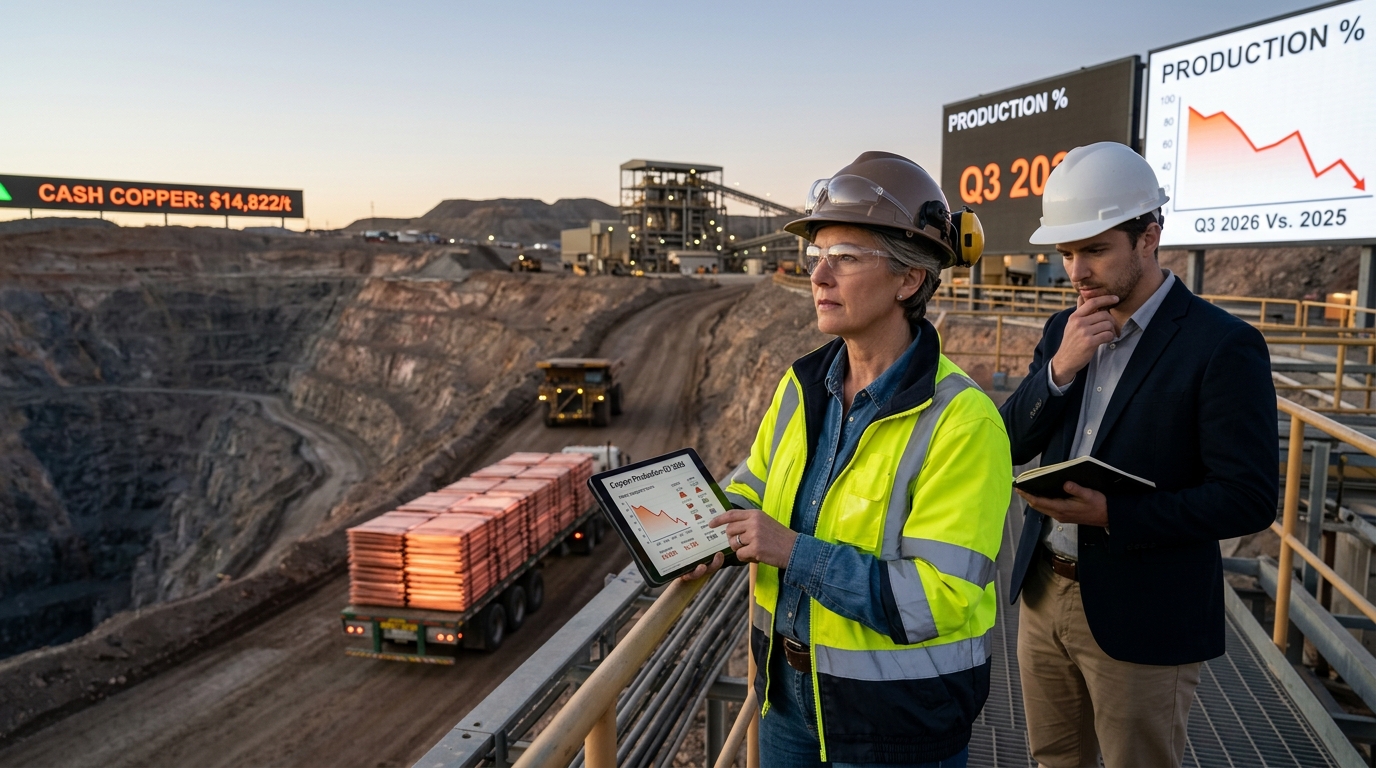
The investment committee argument about BHP sharpens considerably when you lay two numbers next to each other. Copper production totalled 400,700 tonnes in the quarter ended September 30, 2026, down 19% both year on year and quarter on quarter. And cash copper settled at a record $14,822 a tonne on Monday, with LME inventories falling for seven straight sessions to 229,650 tonnes. A mining company produced sharply less of something the world just priced at an all-time high. That is the debate.
Why the Numbers Look Worse Than the Guidance Implies
BHP maintained its FY2027 copper production guidance at 1.65 to 1.80 million tonnes, but the quarter’s Escondida result carries the most weight. The mine produced 252,600 tonnes, down 23% year on year and 19% quarter on quarter, as lower feed grades, scheduled maintenance, severe weather, and a temporary suspension following a fatal accident on September 23 all weighed on output. BHP had already flagged the grade deterioration. Escondida’s average concentrator feed grade is guided at around 0.70% for FY27, versus 0.90% in FY26 and 1.02% in FY25.
The guidance math is plausible only if the back three quarters of the financial year recover meaningfully. To hit 1.65 million tonnes full-year, BHP needs roughly 1.25 million tonnes from October through June on current portfolio composition. That is achievable if the grade schedule holds, but it leaves very little room for a second maintenance disruption in Chile.
The Bull Case: Price More Than Compensates
The average realised copper price was US$7.01 per pound, up 53% from US$4.59 per pound a year earlier and up 7% on the June 2026 quarter. For institutional holders, that is the crux of the bull argument: revenue per pound is running so far above year-ago levels that a volume shortfall of this magnitude is largely offset. Copper contributed more than half of BHP’s FY26 underlying EBITDA, supported by higher realised prices and FY26 group copper production guidance of 1.9 to 2.0 million tonnes. At $7-plus a pound in Q1 FY27, even a lighter volume quarter produces a healthy cash contribution.
BHP’s structural copper story also extends beyond this quarter. The company is advancing a plan to grow Copper SA’s copper production to around 500 kilotonnes per annum by 2035 and up to 650 kilotonnes per annum by 2040. The Jansen potash project is 87% complete. For patient capital, the integrated platform argument still holds.
The Bear Case: You Are Buying Operational Risk at a Record Metal Price
The harder question is whether BHP is the correct vehicle at this point in the copper cycle. Goldman Sachs separates a short-term tariff and inventory squeeze from a durable deficit, and prices above $14,000 to $15,000 a tonne can trigger substitution, project deferrals, and more recycling. If the metal price has peaked or corrects, a miner with declining grades and maintenance exposure in Chile captures the downside in full.
The supply picture is not tightening from BHP alone. Anglo American’s copper production also decreased, by 5%, to 174,900 tonnes in Q3, primarily driven by unprecedented weather events in Chile and the processing of lower-grade stockpile ore at Collahuasi. Both of the world’s largest listed copper miners reported lower output on the same morning, yet copper did not move dramatically because the structural deficit argument is already priced. The Centinela risk that had been supporting prices is now resolved: workers from two unions at Chile’s Centinela mine ratified a new collective bargaining contract, ending a strike of more than a week. Supply risk premiums are unwinding at the margin.
What Investors Are Missing: The Grade-Versus-Price Timing Problem
The overlooked issue is that BHP’s output trough and the copper price peak may coincide. Escondida grades are at their lowest point in years precisely when the metal is at its most expensive. The miner is selling less of what the market values most, then expects production to climb as the grade schedule normalizes. If copper softens into that volume recovery, BHP captures neither the record price at full volume nor the volume recovery at record prices.
Freeport-McMoRan, by contrast, is ramping toward higher Grasberg volumes as grades are improving from their own trough. Third-quarter 2026 consolidated copper production of approximately 830 million pounds approximated expectations, with slightly better results from international operations offsetting slightly lower production in the U.S. That trajectory runs in the opposite direction to BHP’s current grade curve.
Stocks to Watch
BHP (ASX: BHP / LSE: BHP): The volume trough is known and priced to some degree. The question is whether Q2 and Q3 FY27 confirm the recovery that keeps guidance intact. Any further Chilean disruption reopens the guidance debate immediately.
Freeport-McMoRan (NYSE: FCX): Ramping Grasberg volumes into a record copper price environment positions FCX as the asymmetric volume story. The company’s leaching technology could also unlock copper from stockpiles containing an estimated 38 to 40 billion pounds of material previously treated as unrecoverable by traditional leach methods.
Anglo American (LSE: AAL): Its merger with Teck to form a copper-focused global metals and minerals champion continues to progress, with completion still framed within the originally announced window of September 2026 through March 2027, subject to final regulatory approval. A cleaner, copper-heavy portfolio at record prices is the thesis, assuming the deal closes on schedule.
Antofagasta (LSE: ANTO): Centinela is back to normal operations after last week’s settlement. The resolution removes a key near-term operational risk, supporting stable copper production amid tight global supply. Of the major Chilean producers, Antofagasta has the cleanest near-term production profile heading into Q4.