
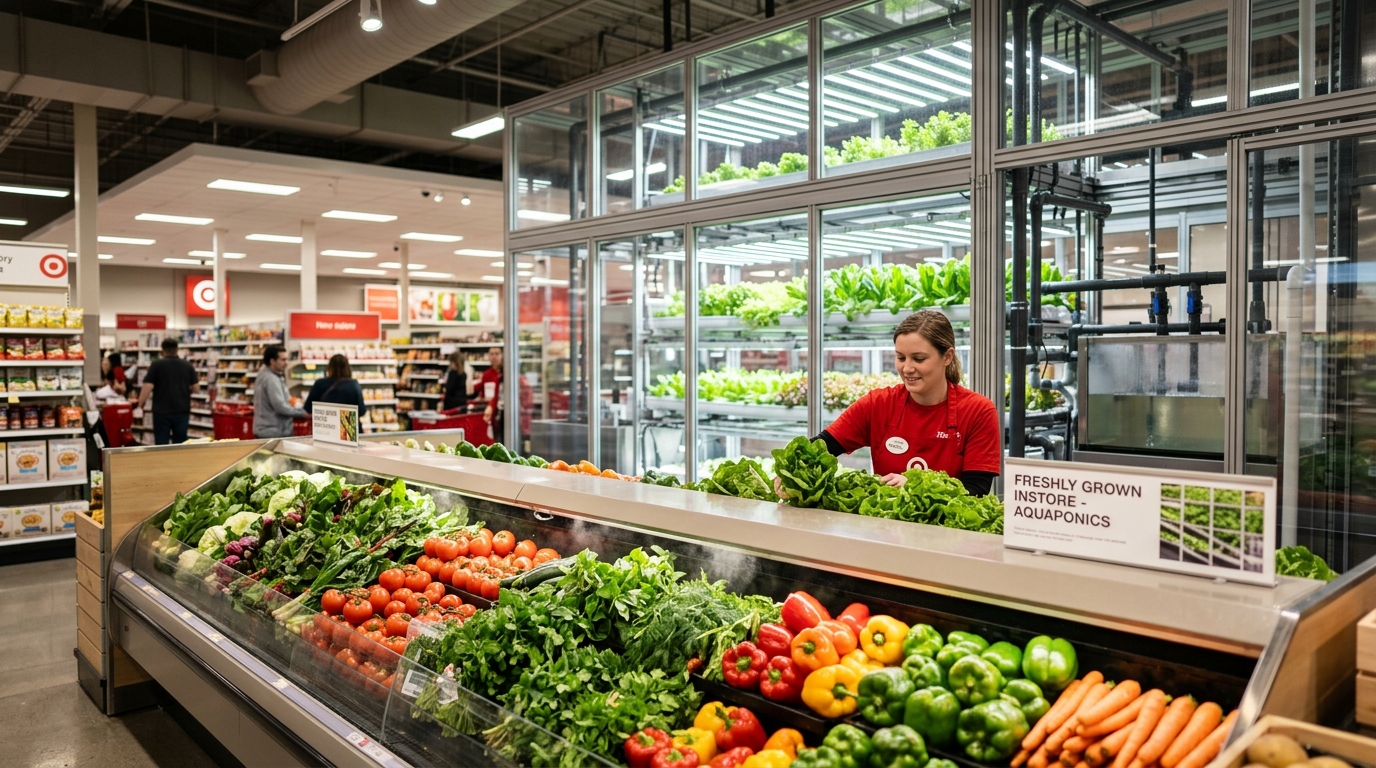
Target’s fresh food push is no longer a side project. In fiscal 2026, the company executed what Chief Merchandising Officer Cara Sylvester called “the largest reset that we’ve had in this area in over a decade,” resetting nearly half of its center-store grocery assortment and accelerating its pace of newness in food by nearly 50%. The company is also investing approximately $5 billion in 2026 toward 130-plus remodels, and it has said some remodels will include expanded fresh and frozen food sections. In Q2, Target reported high single-digit growth in Food & Beverage.
That last detail is the one worth sitting with. Two days faster in conventional logistics still means produce traveling hundreds of miles on refrigerated trucks, burning through its shelf life before a customer touches it. The Colorado facility solves a throughput problem. It does not solve a freshness problem near metro hubs like Chicago, Houston, or the New York corridor.
This is exactly the gap that automated aquaponics grids are designed to close. Unlike standard vertical farms that grow plants alone, aquaponics runs a closed-loop system: fish waste feeds the plants, the plants filter the water back to the fish. The result is a dual-output facility producing pesticide-free greens and protein simultaneously, using far less water than conventional agriculture. Some research has reported aquaponics systems can reduce water use by around 90% versus soil agriculture for comparable yields, though results vary by system design and operating conditions.
The retail connection is already forming elsewhere. Vertical farming firms are forming partnerships with large grocery chains to establish automated grow units within or adjacent to stores. Target’s own leadership has tied fresh food investment directly to in-stock rates, and the company reported comparable sales growth of 3.8% in its most recent quarter.
The risk in TGT’s current approach is that it still depends on geography it does not control. Weather-driven supply shocks can still ripple through produce markets, and indoor operators with long-term supply agreements pitch a different value proposition: stable pricing and volume, delivered regardless of what happened in California or Arizona that week.
Target is spending heavily to fix its grocery business. The next question is whether proximity, not just speed, becomes the real competitive moat. Automated aquaponics grids sited near major metro distribution points could guarantee the freshness that no Colorado warehouse can replicate. For a retailer betting its traffic recovery on produce, that distinction matters more every quarter.