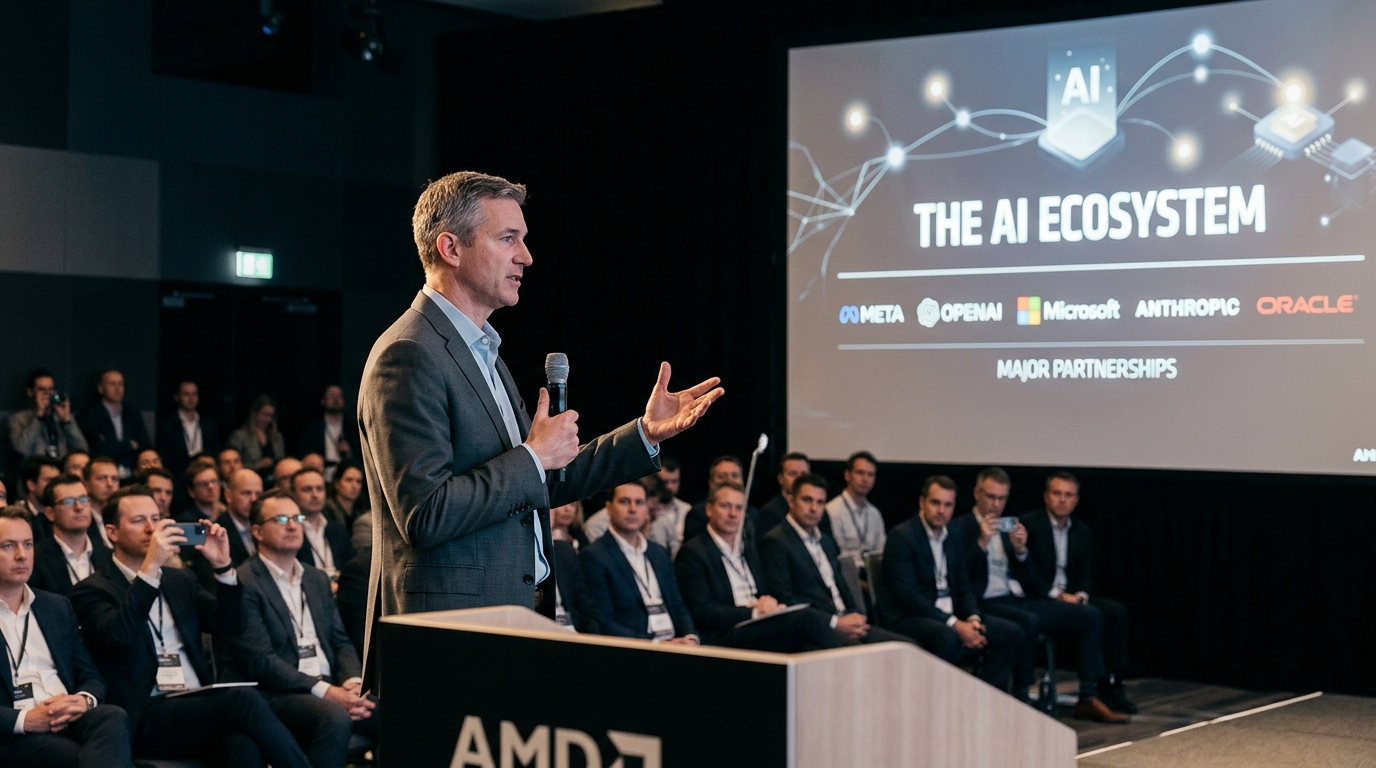
When AMD unveiled Helion at the OCP Global Summit in San Jose on October 12, it did something unusual for a company that spent most of the AI boom playing catch-up: it put the names Meta, OpenAI, Microsoft, Anthropic and Oracle Cloud on the same slide as its own logo. That is not a minor detail. Those five organizations collectively represent the heaviest AI compute spend on the planet.
The question worth sitting with is whether that roster changes the investment case for AMD over Nvidia today, or whether it is the kind of headline that sounds more decisive than it actually is.
What AMD Actually Built
Helion is an open rack-scale reference design based on Open Compute Project specifications, designed to support flexible agentic AI workloads, and it includes an integrated token router that can direct model calls across frontier and open-source models.
Depending on configuration, AMD says Helion can scale to a CPU-only deployment with up to 32,768 Zen 6 CPU cores, using 256-core versions of its EPYC “Venice” processor. In a hybrid configuration, it supports up to 16 Instinct MI350P GPU accelerators and up to 102 Tbps of networking bandwidth.
The architectural logic is deliberate. AMD is not trying to out-GPU Nvidia. Helion embeds a model router into the infrastructure layer, routing each AI agent’s model calls to either a cloud-hosted frontier system or a local open-source model based on cost and latency, rather than defaulting every request to an expensive GPU cluster.
AMD has also said internal testing showed a 43% reduction in token costs. That is a specific, CFO-targeted claim, but readers should treat it as vendor testing until it is replicated externally.
Cisco, Dell Technologies, HPE, Lenovo and Supermicro are all on board, with availability targeted for November 2026.
Why Wall Street Is Paying Attention
The partner list is real. AMD’s Helios rack-scale system, introduced in July, is in production, with first customer shipments expected to start around the end of the third quarter of 2026. Publicly, AMD has named (or described) customers and planned deployments that include Meta, Microsoft, OpenAI, Oracle and Anthropic. Helion is the next layer on top of that momentum.
In 2026, AMD stock surged roughly 187%, outperforming Nvidia’s roughly 22% gain by a historic margin. The why is debatable, but the market has clearly rewarded AMD’s rack-scale push and its credibility with major AI buyers.
AMD CEO Lisa Su has said inference will make up about 60% of AI compute in 2026, and she has argued that agentic AI could drive the CPU market beyond $200 billion by 2030. The Helion design is AMD’s structural bet on that projection. If agents run primarily on CPUs rather than GPU clusters, AMD’s EPYC business becomes more central to AI infrastructure than the market priced in at the start of the year.
Nvidia moved at the same summit. Nvidia contributed key Vera Rubin rack and compute tray designs to OCP through its open MGX architecture, giving system builders a common foundation for developing next-generation AI factory infrastructure. Nvidia also says Vera Rubin delivers 10x agent throughput at scale compared with the previous-generation Grace Blackwell platform. Openness is no longer AMD’s exclusive selling point.
What Could Go Wrong
The valuation is stretched. AMD’s stock has been trading around the high 30s to roughly 40x forward earnings in recent snapshots, while Nvidia’s forward multiple has been cited closer to the mid-teens to around 20x, depending on the source and estimate set. The point stands even if the exact multiples move around day to day: AMD is priced for a lot more perfection right now.
Valuation compression after a strong run is not unique to AMD. Meta beat earnings by 57% and still traded roughly 26% below its 52-week high, showing how a rich forward multiple can override a dominant operating result.
There is also a production timing gap. Helion is being positioned for availability starting in November 2026, but AMD has also described broader timing that extends into 2027 as Zen 6 deployments ramp. Nvidia, meanwhile, is already talking about hundreds of supply chain partners across 350-plus factories in 30 countries ramping Vera Rubin production. AMD is still building that manufacturing base. Being the preferred CPU for agentic execution is a different category from dominating GPU-centric training, but Nvidia is not standing still in either lane.
The Bottom Line
Helion is a credible product answering a real demand shift, and the partner endorsements from Meta, OpenAI, Microsoft and Oracle are not decorative. They reflect procurement and deployment plans already underway around AMD’s Helios platform. The thesis that agentic AI runs on CPUs more than GPUs is plausible, and AMD is better positioned for that outcome than it was 18 months ago.
But the stock has moved. With AMD up nearly 190% year to date and carrying a much richer forward multiple than Nvidia in many recent snapshots, it is priced for a future where it keeps taking share quickly, and where Nvidia does not close the gap in agentic workloads. Given that Nvidia is shipping its own CPU roadmap, opening its rack designs, and making 10x agent throughput claims on Vera Rubin, that is not a safe assumption. AMD is the more interesting story this week. Nvidia may still be the safer trade.