October 7, 2026
Bonus Content: Georg Fischer’s Liquid-Cooling Orders Doubled. Parker Hannifin Is Next.
If you have $25,000 or more in the bank or a retirement account, read this now!
Dedollarize News
October 26: Four Systems. One Deadline.
Click Here to See Why October 26 Matters
Who gets a say in the financial systems handling YOUR money?
On October 26, 2026, public-comment windows close on four federal information collections covering bank deposits, financial customer-data security, securities-market activity and institutional trade settlement.
Four proceedings. One deadline.
Before that deadline, watch what former Goldman Sachs president Gary Cohn said at the public FDIC meeting on November 9, 2022:
“I almost think you’d scare the public if you put this out.”
They were discussing how to explain the resolution of major financial institutions while maintaining public confidence.
The meeting was public. The words are in the transcript.
6,714 matching bank-branch closing records since the day he said it.
That is the result reported in our FDIC BankFind search from November 9, 2022 through September 30, 2026, using data labeled September 29, 2026. These are branch-closing records, not failed banks.
Watch Gary Cohn’s Words and See the Live Branch-Closing Counter.
And when the FDIC recently invited comments on renewing its branch-deposit survey, it received ZERO.
America’s financial infrastructure is changing in plain sight. How closely are you watching?
Watch the exchange, follow the live branch-closing counter and read about the four proceedings before their comment windows close.
Click Here to Watch Before October 26.
Bill Brocius
Author of The Vanishing Dollar and Digital Dollar Exposed
Dedollarize News
Georg Fischer’s Liquid-Cooling Orders Doubled. Parker Hannifin Is Next.
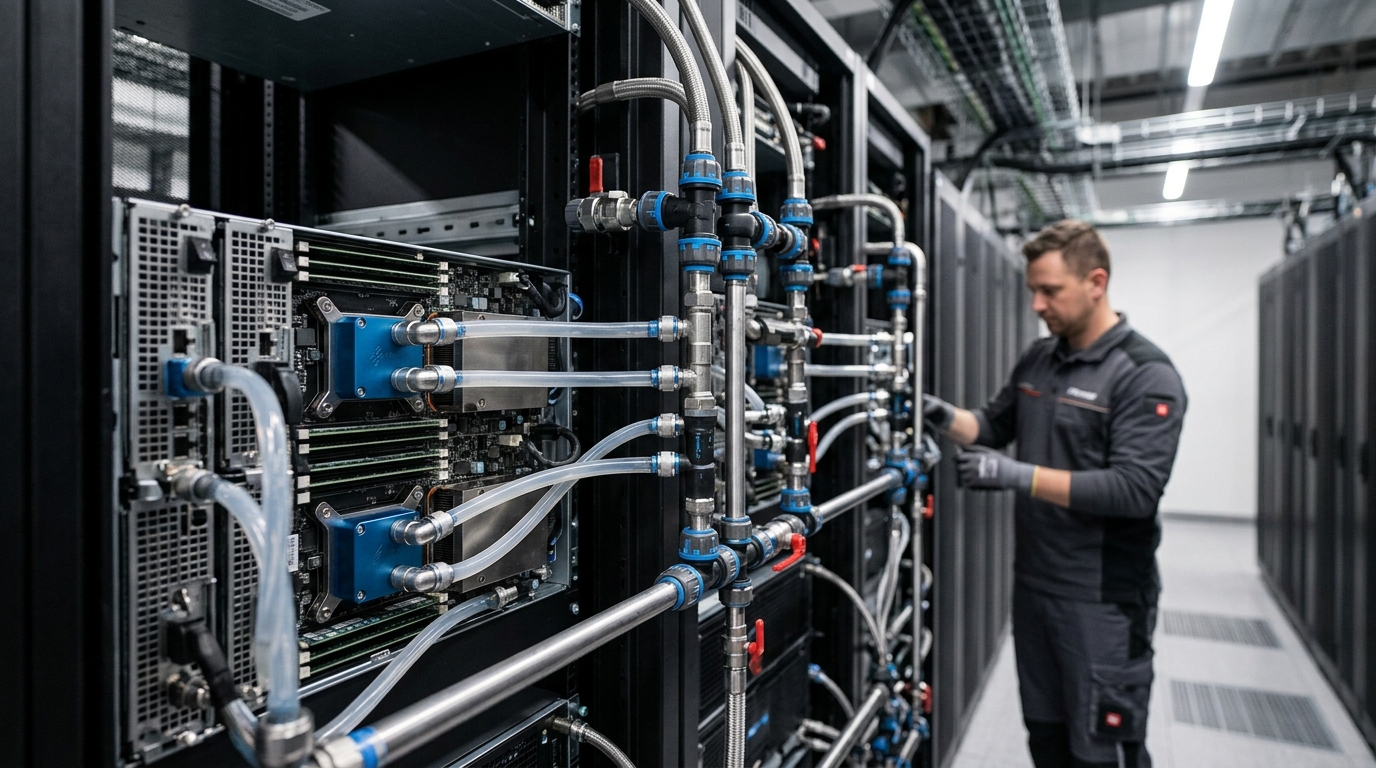
Nobody talks about the plumbing. They talk about Nvidia’s GPUs, about Vertiv’s power systems, about the megawatts. But high-density AI racks that move beyond air cooling ultimately need liquid cooling distribution hardware, and the industrial suppliers who make it are sitting on an order surge that the broader market has not yet priced.
The physics are unambiguous. High-density installations are already pushing well beyond conventional rack densities, and next-generation AI deployments are widely expected to drive rack power higher still. As power density rises, air cooling becomes increasingly difficult to scale on its own, and liquid cooling becomes a practical requirement for many configurations. Every rack that goes liquid needs manifolds, valves, quick-disconnect couplings, and precision fluid control. That is not optional infrastructure.
The order signal arrived in July. In its mid-year results for the first half of 2026, Georg Fischer said order intake for the data center end-market doubled versus the prior year period as it expanded its direct-to-chip liquid cooling offering.
Parker Hannifin tells a subtler but equally useful story. Data centers remain a small part of Parker’s total revenue, but the company has been highlighting “data center cooling” and “liquid cooling systems and subsystem” opportunities as a rapid-growth area in investor materials. That low base matters: the company is positioning liquid-cooling components such as quick-connect couplings, fluid handling, and thermal management hardware as essential building blocks for next-generation facilities. One percent of a roughly $20-plus-billion revenue base moving to five percent is a different business.
The manifold market itself is still small. MarketsandMarkets projected in June 2026 that the global data center liquid-cooling manifolds market would grow from $0.94 billion in 2026 to $6.33 billion by 2033, a compound annual growth rate of 31.2%. The compounding is the point.
What makes this angle genuinely interesting is the bottleneck dynamic. A handful of suppliers dominate key connector categories in liquid loops, and qualifying a new supplier can take a long time because reliability, leakage tolerance, and hyperscaler qualification processes are unforgiving. That is not a moat built on brand loyalty. It is a moat built on qualification cycles and approved-vendor lists.
M&A is already reflecting this scarcity. Ecolab announced in March 2026 that it agreed to acquire CoolIT Systems, and later said it had closed the deal. Eaton said in March 2026 that it completed the acquisition of the Boyd Thermal business of Boyd Corporation. And in October 2024, Schneider Electric said it would acquire an initial 75% controlling stake in Motivair, pending regulatory approval. Every deal compresses the list of independent suppliers further.
The case for Georg Fischer and Parker Hannifin is not that they will become AI companies. It is that they are the pipes the AI companies cannot build without, in a market showing sharply higher order intake with qualification barriers protecting incumbents from new competition.