September 26, 2026
Bonus Content: GoDaddy Is in Play. The Stock Is Worth Owning Either Way.
Look at what’s happened to these seven gold miners:
MAG Silver – up 56.6%
Reunion Gold – up 71.9%
Calibre Mining – up 107.7%
Probe Gold – up 166.7%
Rupert Resources – up 177.9%
Loncor Gold – up 181.8%
G2 Goldfields – up 1,228.6%
These weren’t lucky picks or lottery tickets. Every one of them moved for the same reason – and it’s a reason you can see coming.
Go here to see the pattern behind all seven.
Each of these was a small gold miner sitting on assets a major wanted. And one by one, the majors came and bought them.
Now here’s the part that matters: all seven were in my portfolio before the buyouts happened.
Not seven picks out of hundreds. Seven names, all held ahead of the acquisition – because the same signal flagged every one of them. Once you understand what the majors are forced to do, spotting the next target stops being luck and starts being pattern recognition.
Here’s why that pattern isn’t slowing down – it’s accelerating.
The major gold miners have a problem. Their own production is shrinking. Every ounce Barrick or Newmont pulls out of the ground makes their remaining mine worth a little less – a gold mine is a shrinking asset in slow motion.
At the same time, the majors are sitting on the most cash they’ve ever held, thanks to today’s gold prices.
So a major has exactly two options: watch its output shrink until it’s out of business… or use that record cash to buy the best small miners and replace what it’s losing.
That’s not a choice. It’s survival. Which means the buyouts don’t stop – they keep coming, one after another, until the best small assets are gone.
And here’s what that looks like from the outside, if you own one of those small miners before the major comes knocking:
You go to bed owning a small gold company.
Overnight, a major announces it’s buying that company – at a premium.
You wake up, and your shares are worth 40%… 67%… even 79% more than when you closed your laptop the night before. No chart to watch. No trade to time. The value reprices instantly, while you sleep.
That’s already happened to all seven companies above – every one of them in my portfolio before it did. The only question left is which small miners are next – the ones with the grade, the cash flow, and the assets the big players actually need.
My name is Garrett Goggin, CFA, CMT. My readers had the chance to hold all seven of those names before the majors bought them – and it’s why Porter Stansberry recently called me:
“THE most knowledgeable gold investor in the world.”
Go here to see the three names I believe are next in line to get bought.
Best,
Garrett Goggin, CFA, CMT
Lead Analyst and Founder, Golden Portfolio
GoDaddy Is in Play. The Stock Is Worth Owning Either Way.
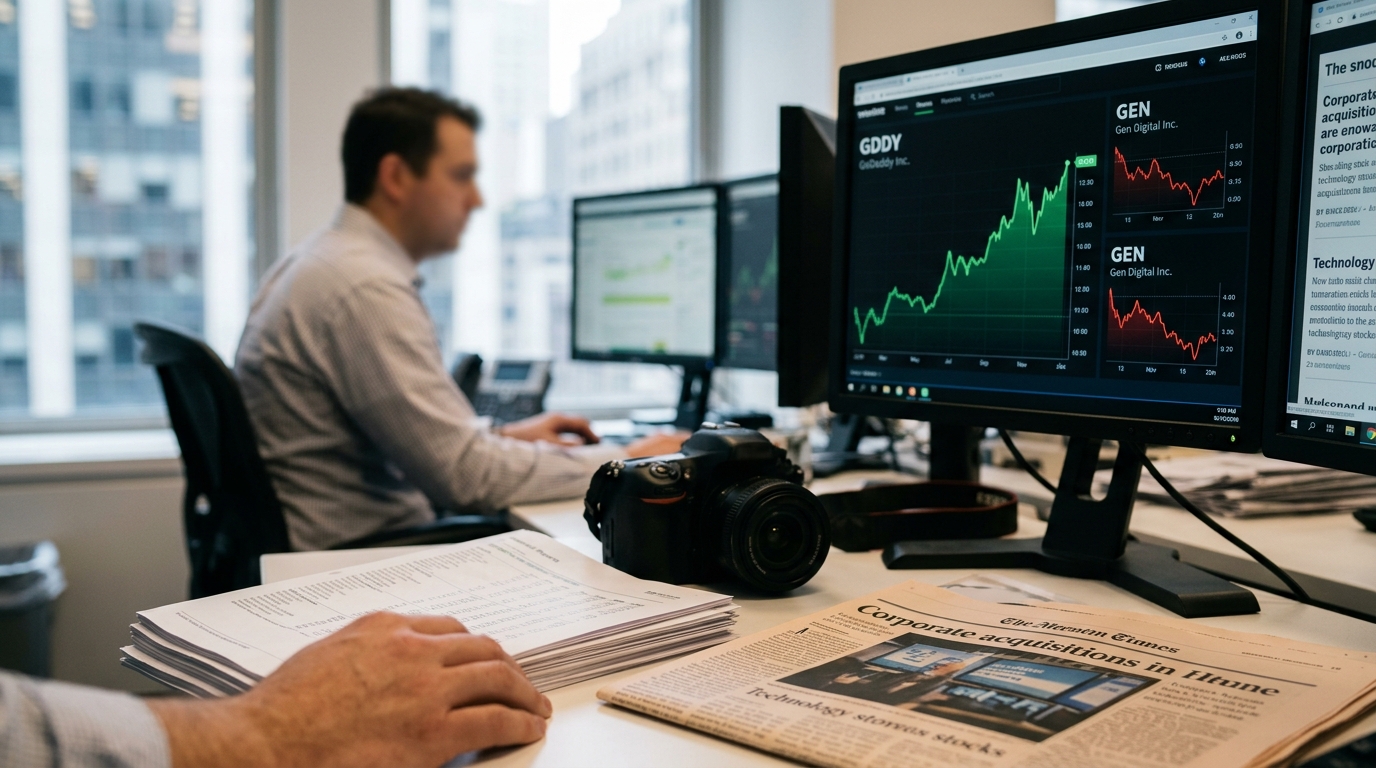
When the Financial Times reported on September 24, 2026 that Gen Digital had made a preliminary approach to acquire GoDaddy at roughly $12 billion, the market delivered an unambiguous verdict: GoDaddy surged as much as 11% that day, while Gen Digital fell 12% to $23.07, the largest large-cap decline of the session. By the close on Friday, September 25, Gen Digital was down about 20% from its September 23 close.
The conventional read is that Gen Digital’s shareholders punished their own company for overreaching. A $12 billion target dwarfs Gen Digital’s own market value, and funding it would likely require heavy new debt or diluted equity. Merging a consumer cybersecurity business built around Norton, Avast, and LifeLock with a domain-registration and web-hosting company strikes many investors as a stretch. StoneX notes roughly $8 billion of net debt at Gen Digital, while GoDaddy reported $3.8 billion of total debt as of June 30, 2026, suggesting any transaction would likely need a sizable equity component.
The skepticism is partly a reflection of how the market is currently valuing cybersecurity businesses more broadly. Investors have grown more demanding about whether strong revenue growth justifies stretched multiples, and that scrutiny is landing on the sector’s biggest names. Bernstein’s recent downgrade of a top cybersecurity company and what it means for valuation captures exactly the kind of premium-versus-fundamentals debate that makes Gen Digital’s shareholders nervous about adding more exposure at a $12 billion price tag.
That is all Gen Digital’s problem. The more interesting question is what the episode tells you about GoDaddy on its own.
The Business
GoDaddy is the dominant name in domain registration, web hosting, and small-business digital infrastructure, serving over 20 million customers globally. The company operates in two segments: Applications and Commerce, and Core Platform. The A&C segment offers website building, e-commerce tools, marketing services, and Microsoft 365 connectivity. That description undersells the shift underway inside the company.
Airo, GoDaddy’s AI platform, reached an annualized bookings run rate of $50 million in the second quarter, five times the $10 million reported just one quarter earlier. Over 70% of Airo users have two or more products, and free-to-paid conversion rates are improving. This is not a company in decay. It is a company mid-transition into higher-value recurring revenue.
Why Wall Street Is Paying Attention
GoDaddy delivered strong Q2 financials: revenue grew 7% to $1.3 billion, normalized EBITDA margin expanded over 200 basis points to 33%, and free cash flow rose 13% to $443 million. Full-year free cash flow guidance was reaffirmed at approximately $1.8 billion.
Capital allocation is aggressive: GoDaddy repurchased $852 million in shares year-to-date, reducing share count by 7%, and is on track for a 25%-plus three-year compound annual growth rate in free cash flow per share. Baird raised its price target to $120 from $110 this week. Even Wells Fargo, which has a sell rating, cannot ignore the free cash flow engine.
Now add the takeover premium. The initial approach was reportedly made in recent weeks, with discussions still at an early stage. A combination would bring together GoDaddy’s domains, hosting, and payments business with Gen Digital’s Norton, Avast, and LifeLock cybersecurity portfolio. Whether or not Gen Digital returns to the table, the approach signals that strategic buyers view GoDaddy’s customer base as a distribution asset worth paying up for.
GoDaddy is not an isolated case. The conditions driving strategic acquirers toward cash-generative, subscription-oriented businesses have been building for months across the technology and services landscape. why Goldman Sachs sees a multi-year M&A supercycle just getting started lays out the macro backdrop that makes a company with $1.8 billion in annual free cash flow and 20 million customers an obvious target for a deal-hungry acquirer.
What Could Go Wrong
The deal risks are real. Discussions remain at an early stage and there is no guarantee the approach will ultimately lead to a transaction. If Gen Digital walks away entirely, some of the takeover premium evaporates from the stock.
GoDaddy’s stock took a sharp hit in late February 2026 after results and outlook disappointed investors, and securities class-action filings began appearing in September 2026 alleging misleading disclosures tied to customer acquisition and promotions. That litigation could complicate due diligence for any acquirer and weigh on sentiment in the near term.
The transition to Airo is causing a deliberate trade-off, with A&C bookings expected to remain in high single digits for the rest of 2026. Meanwhile, management has flagged headwinds from its .CO registry contract expiration and an accounting change for certain high-value aftermarket domain transactions that together pressure reported revenue growth. These are manageable headwinds, but they cap near-term upside on a standalone basis.
The Bottom Line
GoDaddy at roughly $97 per share offers something unusual: a cash-generative, AI-transitioning web-services business that is now officially in play. The company’s free cash flow yield is in the low-teens based on recent trailing free cash flow. If Gen Digital or another acquirer closes a deal, shareholders collect a premium. If the talks collapse, the $1.8 billion free cash flow target and the buyback program provide their own support. The stock has two ways to win and one way to wait.
That two-outcome framework — collect a premium or fall back on the underlying business — is becoming a recurring theme in deals where regulatory or financing uncertainty is high. The structure forces investors to do the work of valuing the company as if no deal ever happens. how Chime’s Stride acquisition tests the same standalone-versus-deal calculus for investors offers a useful parallel for thinking through what GoDaddy is actually worth if Gen Digital never comes back to the table.