
September 26, 2026
Bonus Content: Nvidia Guides to $108 Billion Next Quarter
Hi Trader,
Most “gurus” who teach beginners how to trade options start in the wrong place…
Because they immediately launch into complicated concepts like Greeks, spreads, and implied volatility.
And before long, most new traders are completely lost… and move on.
The free guide I want to share with you today takes a different approach.
Instead of overwhelming you with technical details…
It starts with the basics and shows you exactly how options work, why traders use them, and how they can fit into a simple trading plan.
If you’ve ever wanted to understand options but didn’t know where to start…
This is your chance.
Click here and get your free copy now.
To your trading success,
Dave Aquino
Lead Options Trader, Base Camp Trading
Nvidia Guides to $108 Billion Next Quarter
Nvidia told you something unusual for a company at this scale: it cannot build fast enough. Jensen Huang said on the Aug. 26, 2026 earnings call that, even though demand is higher, Nvidia’s supply allows it to deliver about 70% of what customers want. In that same discussion, management also put a preliminary marker out for roughly 70% revenue growth in fiscal 2028. That is not a growth forecast. It is a capacity-constraint acknowledgment from a company generating nearly $100 billion per quarter.
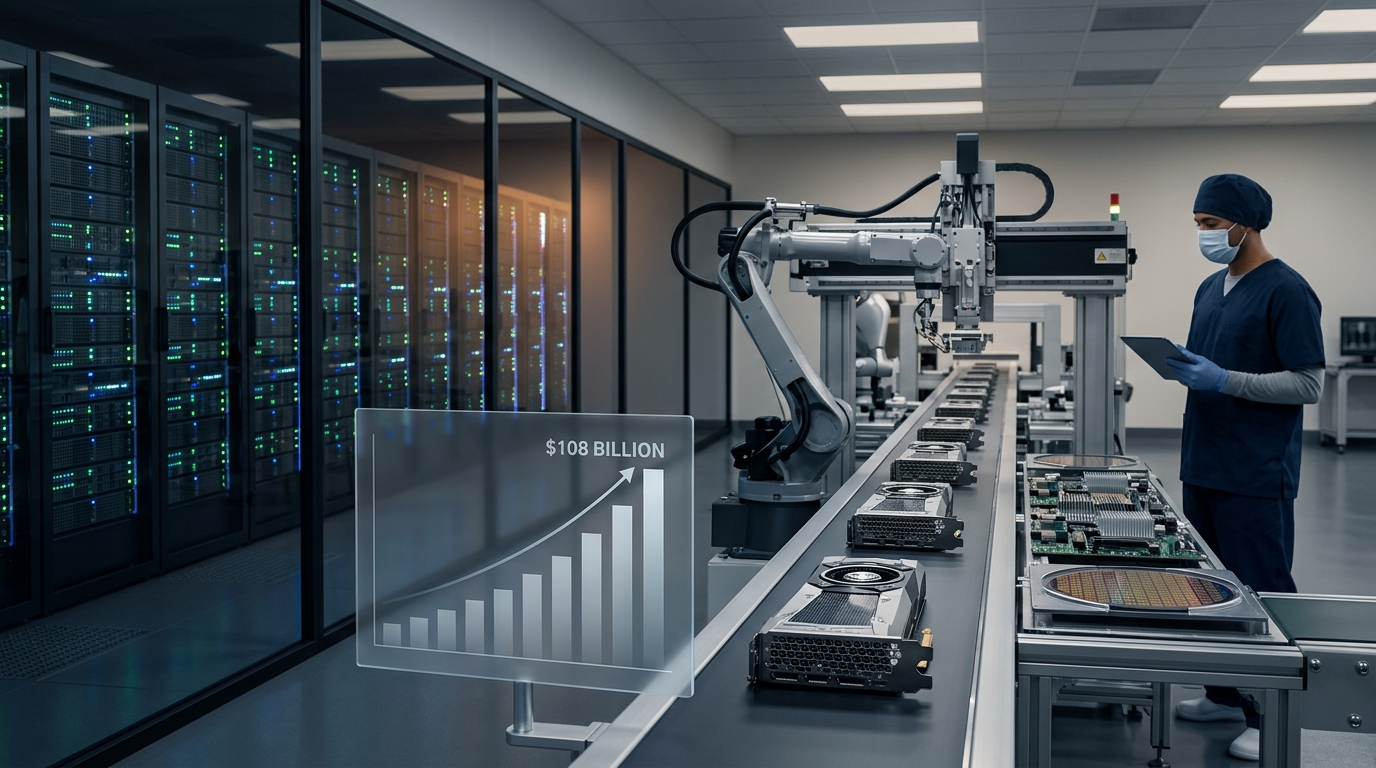
Q2 results and Q3 guidance. Revenue for the quarter ended July 26, 2026 came in at $96.2 billion, up 106% from a year ago. Data center revenue reached $89.0 billion, up 117%. The Q3 guide is $108.0 billion, plus or minus 2%, and Nvidia said it is not assuming any Data Center compute revenue from China in that outlook. CFO Colette Kress said on the earnings call that Vera Rubin will account for about 20% of data center revenue in Q3. With data center making up more than 90% of total revenue at current levels, that implies roughly $20 billion from a product in its first real quarter of shipments.
Why the Multiple Is Misleading
The stock trades near $225. That looks steep until you model forward. On fiscal 2027 estimates, the price is about 24.1 times earnings. On fiscal 2028, it drops to approximately 14.5 times. The price is the same. The earnings have not arrived yet. Fiscal 2028 EPS consensus moved from $12.82 thirty days ago to $15.68, with 42 upward revisions and zero downward.
The Vera Rubin platform is what drives those revisions. Revenue opportunity per gigawatt rises from roughly $18 billion on Hopper to $25 billion on Grace Blackwell to $40 billion on Vera Rubin. Multiply that across the hyperscaler buildout and the math changes quickly. Cloud industry backlog exceeds $2 trillion, with top-five hyperscaler capital expenditures tracking to nearly $800 billion in 2026 and $1.3 trillion in 2027.
The Vera Rubin ramp is the latest in a series of architectural leaps Nvidia has used to expand its addressable revenue per customer. Each new platform has reset what the market thought was possible, a pattern that has repeated with striking consistency over the past several product cycles — as explored in how Nvidia’s latest chip launch opened an entirely new revenue frontier. Understanding that cadence matters for judging whether Vera Rubin is a one-time event or part of a durable structural shift.
What Could Go Wrong
Two risks are known and quantified. Supply commitments have ballooned to $279 billion, primarily for the procurement of memory. Management guided Q3 gross margins to about 74%, and said margins are expected to bottom in Q4 in the 71% to 72% range as memory costs rise. A margin trough in late fiscal 2027 could disappoint investors expecting 75% gross margins to hold permanently. China remains an uncertain market. Q3 guidance explicitly excludes China data center revenue, and Nvidia said shipments of Data Center Hopper products to China were less than 1% of Data Center revenue in Q2.
That uncertainty makes the diversification of Nvidia’s revenue base more important than it might otherwise appear. Jensen Huang has been explicit that the next phase of growth runs through physical AI and robotics — markets that are largely independent of the geopolitical restrictions affecting data center chip exports. Nvidia’s robotics and physical AI expansion thesis and what the market hasn’t priced in lays out why that pipeline could matter more to the long-term bull case than any single quarter of China revenue.
The demand story is real. The execution risk on Vera Rubin is real too. Any production stumble on what management is calling the fastest product ramp in company history would hit the stock hard.
The Bottom Line
Nvidia is supply-constrained into the fastest product ramp in its history, guiding to $108 billion next quarter, with 42 analyst estimate revisions pointing up and zero pointing down over the past month. At 14.5 times what the street already expects it to earn two years from now, the multiple is not demanding for a business where every major hyperscaler has a confirmed order. Management called Vera Rubin the fastest product ramp in Nvidia’s history, and CFO guidance has been right eight straight quarters. The margin compression ahead is a known cost. Whether it arrives as scheduled or overshoots is the only remaining variable that matters.


![This has already happened to seven gold miners [here’s the list]](https://www.tradingstocksnow.com/wp-content/uploads/2026/09/67dcdbdf-c35c-4124-a572-82194b6e19f2-768x429.jpg)