September 8, 2026
Bonus Content: ExxonMobil Paused Its $7B Hydrogen Dream.
Why Is the U.S. Backing a Critical-Metal Project With Billions?
When Washington is willing to back one project with up to $2.9 billion, investors might want to pay attention to what it is trying to secure.
One of the answers is antimony.
The U.S. Export-Import Bank has pledged a loan of up to $2.9 billion toward completing an Idaho project expected to become an important source of this critical metal.
That commitment sends a powerful signal.
America is serious about rebuilding the supply chain behind its weapons, military technology and other essential industries.
But the current project in the spotlight – the Idaho project – may not open until 2029. And even then, it is expected to meet only part of America’s demand.
That means the search for additional supply is far from over and it may also create an opening for emerging companies already closer to home.
One overlooked company has quietly assembled several antimony projects across North America, led by a historic district now receiving a modernized, second look.
They are moving just as Washington’s wallet is opening and the race for secure North American supply is accelerating.
That is a combination to keep an eye on before everyone sees it.
Follow the company moving with Washington’s critical-mineral push…
ExxonMobil Paused Its $7B Hydrogen Dream.
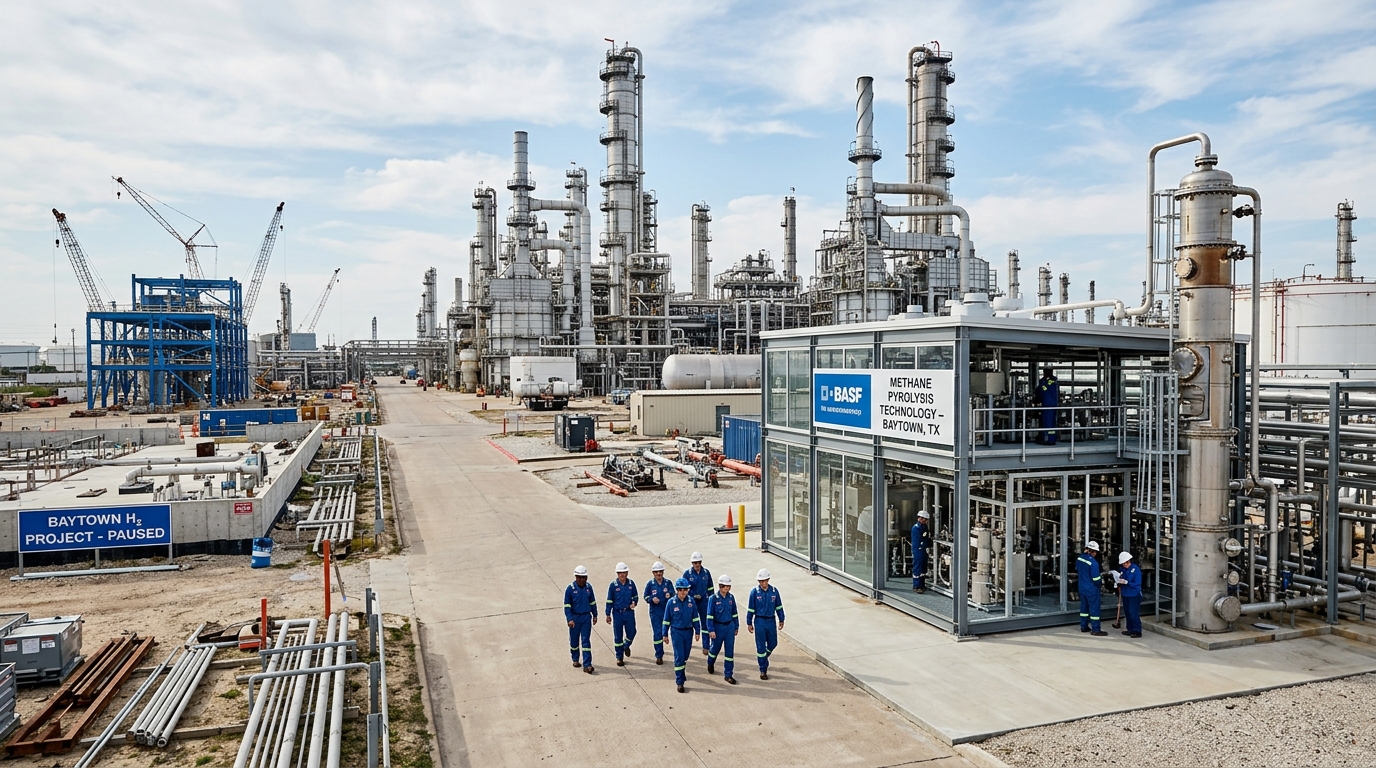
The headline reads like a retreat. In November 2025, ExxonMobil (XOM) indefinitely paused the Baytown, Texas project that was supposed to become one of the world’s largest low-carbon hydrogen plants. The project carried a $7 billion price tag, and CEO Darren Woods confirmed the pause to Reuters, citing weak customer demand and concerns about market development.
Your Power Bill Is Funding the AI Boom
The bulk order that keeps the lights on across 13 states just jumped from $2.2 billion to $14.7 billion – nearly 7x in one year – because data centers are draining the grid. There’s one energy source that runs 24/7 with no fuel, and Washington just preserved its tax credits through 2033 while terminating everyone else’s. Google signed for 15 years. Bill Gates invested $100 million. One company has spent sixty years building it.
What the headline misses: ExxonMobil was already building the replacement before it pulled the plug.
The Business
In November 2025, BASF and ExxonMobil formed a strategic collaboration to advance methane pyrolysis, a technology that produces hydrogen and solid carbon. The companies plan to construct and operate a demonstration plant capable of producing up to 2,000 tons of low-emission hydrogen and 6,000 tons of solid carbon annually, located at ExxonMobil’s Baytown complex.
The distinction from blue hydrogen matters. Methane pyrolysis can avoid process CO2 emissions at the point of hydrogen production because carbon is separated as a solid. It also avoids the carbon-storage chain that defines blue hydrogen. There is no carbon buried underground, no storage liability, no dependence on geological formations. The solid carbon produced is a potentially saleable industrial material. But the claim that the economics “do not require a 45V tax credit” is still a hypothesis, not a proven fact, because the technology and product markets are not yet validated at scale.
Inside the Nuclear Revival Reshaping Energy Markets
Governments worldwide are investing billions to revive a proven energy source. Supply chains are tightening, demand is rising, and select companies stand to benefit. The Nuclear’s Second Act report explains what’s happening next.
The economics of methane pyrolysis still need to be proven at scale, and market demand must mature for both hydrogen and the solid carbon byproduct. That is the honest caveat. It is also, clearly, what the demonstration plant is designed to test.
Why Wall Street Is Paying Attention
None of this low-carbon positioning costs ExxonMobil its core franchise. The oil machine is running at full speed. The company has reported record Permian production of more than 1.8 million oil-equivalent barrels per day in Q2 2026.
The company reported Q2 2026 earnings of $14.5 billion and cash flow from operations of $23.6 billion, generating about $17.2 billion in free cash flow, despite Middle East disruption impacts. Piper Sandler raised its price target on XOM to $185 from $158 on September 3, 2026. The stock was trading around $160 to $161 in early September.
Inside the Nuclear Revival Reshaping Energy Markets
Governments worldwide are investing billions to revive a proven energy source. Supply chains are tightening, demand is rising, and select companies stand to benefit. The Nuclear’s Second Act report explains what’s happening next.
What Could Go Wrong
The methane pyrolysis bet is early-stage by definition, and pyrolysis faces its own version of the scrutiny aimed at blue hydrogen. Industrial buyers willing to pay a premium for low-emission hydrogen remain rare, and the solid carbon byproduct needs durable demand at attractive pricing for the model to work. ExxonMobil’s increased spending to grow volumes also carries the familiar risk of chasing growth into weaker commodity pricing.
The policy environment remains volatile. Any further rollback of hydrogen incentives could shrink the addressable market before pyrolysis has a chance to prove its cost curve, even if the long-term goal is a pathway that can stand on its own.
The Bottom Line
ExxonMobil’s move is more calculated than it appears. Abandoning a mega-project that depended on a still-forming hydrogen market while quietly advancing a technology that can avoid process CO2 and run on existing gas infrastructure is a cleaner bet on hydrogen’s future. ExxonMobil’s Baytown hydrogen work has also involved Technip Energies on the earlier blue hydrogen project’s engineering, underscoring that Exxon has been keeping multiple technical paths active. The oil production finances the patience the hydrogen research requires. If pyrolysis works at scale, XOM already owns the Baytown site. That option has real value, and the market has not yet priced it.