Day 177 of the Strait of Hormuz closure, and the market sent exactly one commercial vessel through on August 16, according to IMF PortWatch data cited by the Straits.live tracker. Against a pre-crisis baseline of roughly 73 transits a day, that figure is not a slowdown. It is a shutdown. And Frontline (NYSE: FRO) is the clearest equity expression of what that shutdown is worth.
Why This Stock Now
Frontline releases preliminary Q2 2026 results on Friday, August 28, with a webcast and conference call scheduled for 3:00 p.m. ET. The stock last traded around $44, and the 52-week high is about $45.17, hit August 19. That proximity is the whole debate: is there more money to make, or has the market already paid for the disruption?
The Business
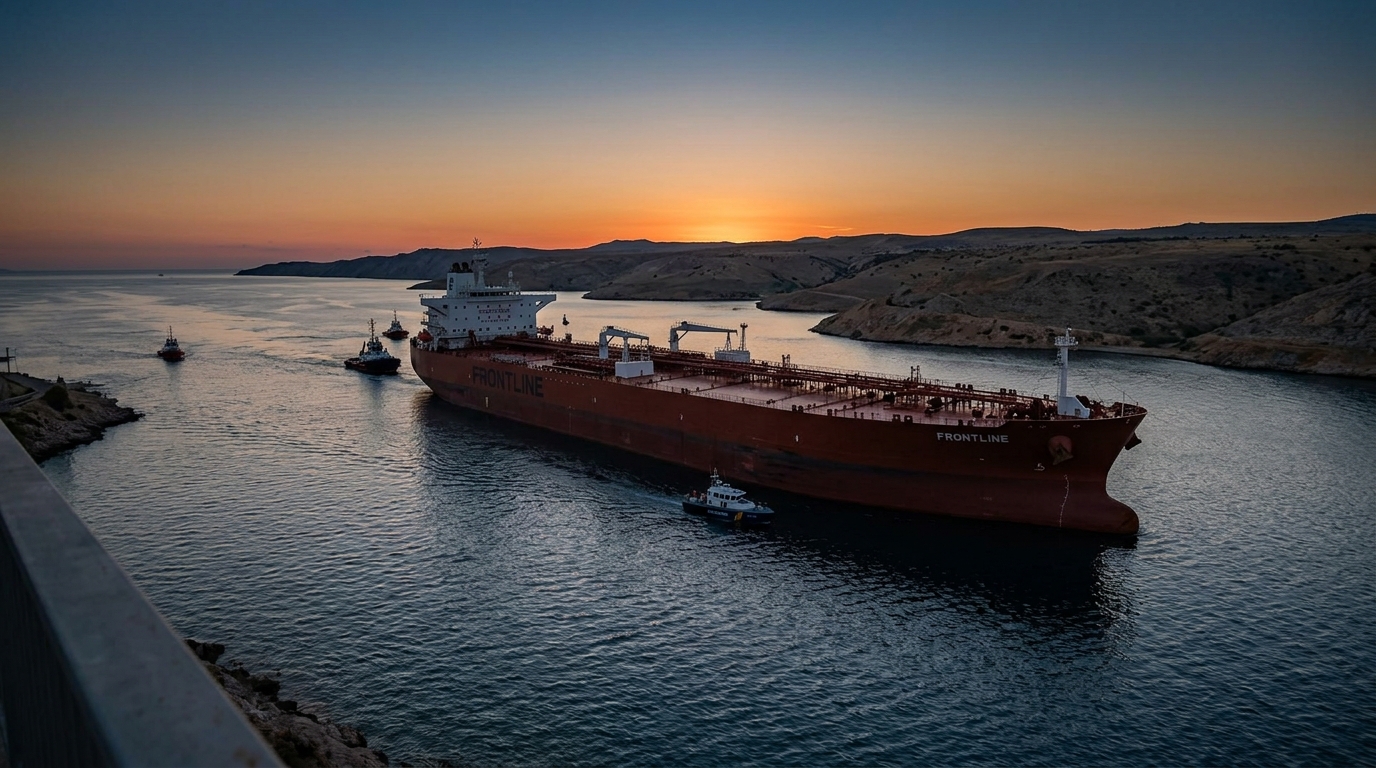
Frontline operates one of the world’s largest fleets of crude oil tankers. As of December 31, 2025, it reported 41 VLCCs, 21 Suezmax tankers, and 18 LR2/Aframax vessels. When the strait closed on February 28, crude that normally moved through the Persian Gulf in days began rerouting onto longer voyages, increasing ton-mile demand that can flow directly into tanker earnings. CEO Lars Barstad captured the posture on the Q1 call: tanker markets can thrive in unstable conditions.
Why Wall Street Is Paying Attention
Q1 2026 delivered Frontline’s strongest adjusted profit since the fourth quarter of 2004, with adjusted earnings of $344.9 million and revenue of $714.2 million. The company also declared a dividend of $1.55 per share for the quarter. More importantly for Q2, the company said it had booked 82% of VLCC days at $181,700 per day, versus Q1 average spot TCE of $103,500.
BTIG raised its price target to $55 from $45, citing tanker demand dynamics. Evercore ISI moved the other direction, downgrading to In Line with a $38 target. The split is a useful map of the risk.
What’s Driving the Opportunity
Freight benchmarks for Middle East Gulf to China VLCCs have been extraordinarily elevated at points during this crisis, with industry briefings showing TD3C levels that would have seemed implausible not long ago. At the same time, war-risk insurance and compliance constraints have continued to deter many operators from transiting the strait, reinforcing the duration risk in both directions.
Frontline is capitalizing beyond day rates. In August, the company reached an agreement to sell two 2017-built VLCCs for $270 million, generating approximately $179 million in net cash and a planned one-time special dividend of $0.80 per share, subject to completion of the sale.
What Could Go Wrong
The bear case has one sentence: a credible US-Iran deal. Barstad has said traffic through Hormuz should quickly increase if Washington and Tehran reach an agreement. That single headline could reset the stock faster than any earnings beat could support it. With the shares already close to their recent peak, the spread between the most bullish and most cautious analyst views is wide enough to matter.
The Bottom Line
Frontline is not cheap on a re-opening scenario. It is cheap only as long as the strait stays closed, which, 177 days in, remains the dominant probability. The Q2 numbers on Friday will almost certainly be strong: 82% coverage at $181,700 per day does most of the math. The real question is whether management’s tone on Q3 visibility, insurance costs, and fleet positioning is enough to push the stock through its 52-week high or becomes the event that lets disciplined holders exit at a full price. Both are legitimate outcomes. The long case still has more behind it than the exit case, but the margin of safety has compressed materially since March.