July 21, 2026
Why KO Is the Stock to Watch This Week
Five analyst upgrades, a FIFA tailwind, and earnings on Tuesday.
Most weeks, the most compelling stock is not the loudest one. This week, Coca-Cola (NYSE: KO) is making the case quietly but clearly. The stock closed at $82.12 on Monday, just off its 52-week high of $85.68. UBS raised its price target to $98 on July 15. Citi followed at $97 on July 13. BofA moved to $95 on July 10. Q2 earnings land before the open on Tuesday, July 28. And sitting underneath all of it is a business that has raised its dividend for 64 straight years and just beat estimates by five cents a share in Q1.
That is a lot happening in one week. Here is what matters and what does not.
Why This Stock, Why Now
Consumer staples have been the leadership sector in 2026, and KO has been at the center of that rotation. As investors have pulled back from high-multiple AI and tech names, capital has moved steadily into cash-generative, low-volatility businesses. Coca-Cola fits that description better than almost any other large-cap stock in the market. Institutional ownership accounts for roughly 64% of shares outstanding. Berkshire Hathaway holds approximately 400 million shares and has not sold a single one. That level of committed institutional positioning does not come from momentum chasing. It comes from conviction in the underlying model.
The immediate catalyst is Tuesday’s earnings report. Analysts are expecting $0.92 in EPS on revenue of $13.17 billion. UBS is a touch more optimistic, modeling $0.94 on organic revenue growth of 3.6%. The company has beaten the consensus estimate in each of the last four consecutive quarters. The bar is not low, but the execution record behind it is unusually consistent.
AI’s “All In” Moment
In the dot-com days, former Wall Street money manager Alexander Green bought Apple under $1. Netflix at $1.62. Amazon under $2. (Split adjusted.)
Now he’s doing the same with AI.
And he says it’s the biggest opportunity he’s seen in 40 years.
Every few decades, a window opens that can change your financial life forever.
The Business Worth Understanding
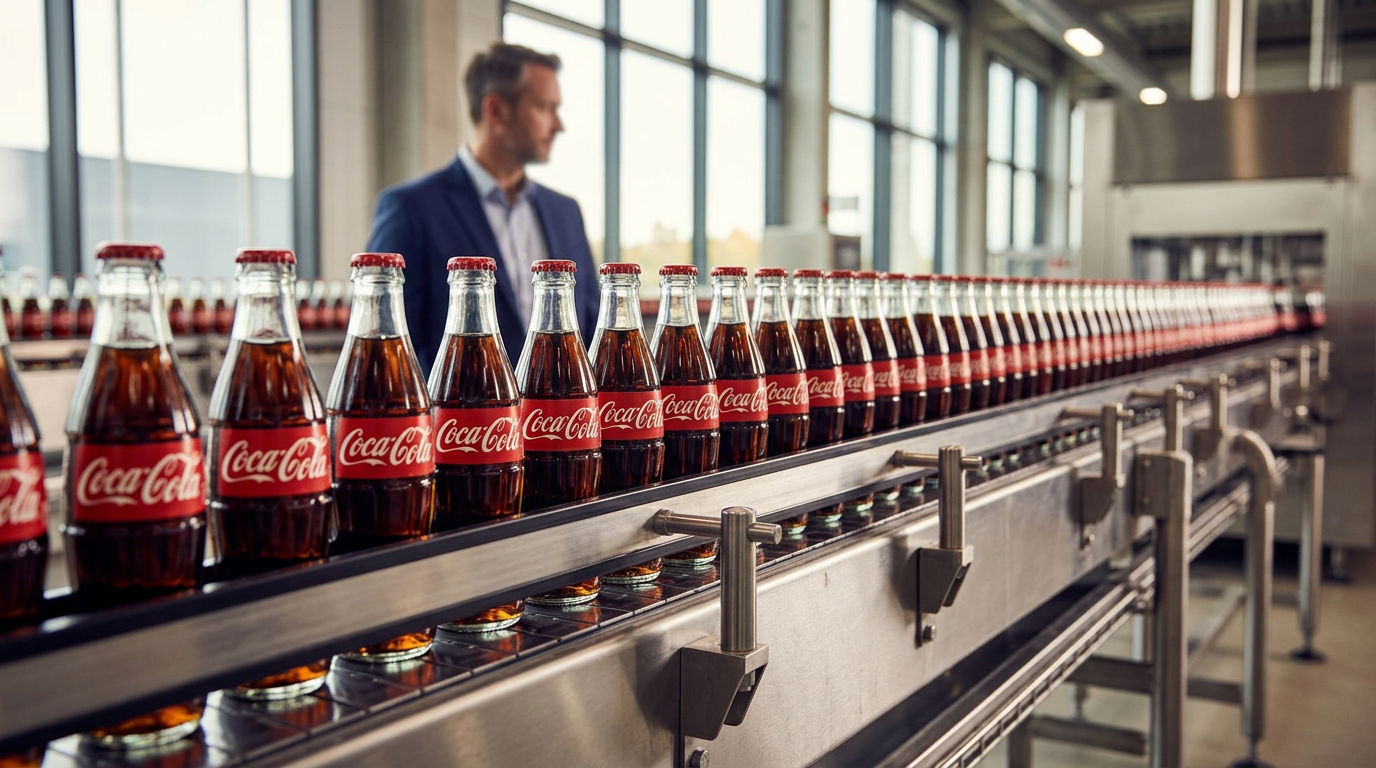
Coca-Cola does not make most of what it sells. The company owns the brands, produces concentrates and syrups, and hands off manufacturing and distribution to a global network of franchised bottlers. That structure matters because it keeps capital requirements low and cash flow high. In Q1 2026, the company generated $1.8 billion in free cash flow and is guiding for approximately $12.2 billion for the full year. Net debt leverage sits at just 1.6 times EBITDA, well below its own stated target range of 2.0 to 2.5 times. The gross profit margin runs at 61.74%. These are not the numbers of a company under pressure. They are the numbers of a business that has figured out how to make money in almost every economic environment.
Two brands inside that model are worth calling out specifically. Coca-Cola Zero Sugar grew 14% for all of 2025, then grew another 13% in Q1 2026, across every geographic segment the company reports. This is not a regional story or a one-quarter blip. It is a sustained volume driver in a category projected to nearly double in size by 2033. Then there is Fairlife, the premium protein dairy brand that posted an estimated $4 billion in sales in 2024 and has been demand-constrained for well over a year. A new production facility is opening in Webster, New York this year, and a $650 million plant in Coopersville, Michigan is targeted for 2028. The company is investing aggressively in its fastest-growing brand precisely because the demand is real.
Why Wall Street Moved This Month
Five banks raised their price targets on KO in July alone. BofA moved to $95 after updating its bottler analysis and concluding that consumption trends remain healthy across most global markets. Citi moved to $97, partially citing the FIFA World Cup 2026 as a meaningful volume catalyst in North America and Latin America, where Coca-Cola is an official tournament partner. UBS raised its target to $98 and expects the company to keep full-year guidance intact or potentially tighten ranges toward the top end. Piper Sandler is at $88, with an Overweight rating, specifically citing what it sees as strong legal positioning in the IRS case. Deutsche Bank reaffirmed its Buy rating as recently as this morning.
Worth noting: Coca-Cola also just signed a global beverage partnership with Marriott International, effective across all Marriott properties worldwide. That is not a headline-grabbing deal, but it is exactly the kind of quiet distribution expansion that compounds over years, not quarters.
Trump redacted 750 files while smelling Biden?
Biden’s smell hadn’t even left the Oval Office yet…
And Trump got to work immediately on the most secretive government operation since the Manhattan Project.
While the world was distracted by tariffs, Trump redacted over 750 government files.
Because Trump saw the writing on the wall: These files were about to destroy everything we love about America.
What Could Go Wrong
Two risks are real and should not be dismissed. The first is the IRS tax case. Oral arguments at the 11th Circuit in Miami were heard on June 25. The dispute centers on transfer pricing between Coca-Cola’s U.S. parent and foreign subsidiaries covering years 2007 through 2009. The IRS won at the Tax Court level in 2020 and 2023. Coca-Cola already paid roughly $6 billion in taxes and interest in late 2024 to stop interest from compounding during the appeal. If the 11th Circuit upholds the Tax Court, total exposure could approach $20 billion, with another $14 billion still potentially owed. The company has reserved only $493 million on a more-likely-than-not basis against that number. The gap between the reserve and the worst-case exposure is genuinely wide. A ruling is not expected immediately, and if the 11th Circuit splits from recent 8th Circuit precedent favoring 3M in a related case, this heads to the Supreme Court and drags on well into 2027 or beyond.
The second risk landed just last week. On July 16, Coca-Cola filed an 8-K confirming a ransomware attack had hit Fairlife’s U.S. operations and temporarily suspended all domestic production. Canadian facilities were not affected. The company has brought in cybersecurity specialists and notified law enforcement, and Morgan Stanley said it would be a buyer on any weakness related to the disruption. But the timing is difficult. Fairlife was already supply-constrained before the attack. The new Webster facility is scheduled to open around now. Any production stoppage during that window almost certainly hit Q2 Fairlife volumes, and investors will want to know on Tuesday exactly how long operations were down and whether they are fully restored.
On valuation, KO trades at roughly 25 times forward earnings. That is a premium to most consumer staples peers. It is not a stock you buy because it is cheap. You buy it because the quality of the earnings justifies paying up, and historically that argument has held.
The Bottom Line
The case for KO right now is not that it is misunderstood or undiscovered. It is that the combination of factors in play this week is unusually concentrated: a catalyst-driven earnings report on Tuesday, a fresh wave of analyst target increases from five major banks, a FIFA World Cup volume boost running through the summer, and two genuine growth platforms in Zero Sugar and Fairlife that both have room to run. The risks are real, but they are known. The IRS case has been on the table for years and the stock has kept climbing. The Fairlife disruption is acute but almost certainly temporary.
For full-year 2026, analysts are modeling EPS of $3.26, up roughly 8.7% from $3.00 in fiscal 2025. The company’s own guidance range implies $3.24 to $3.27. Free cash flow guidance is $12.2 billion. The dividend is $2.12 per share annually, yielding about 2.5% at current prices. None of those numbers are flashy. That is the point. What KO offers right now is a rare combination of quality, momentum, near-term catalysts, and a business model that does not require anything to go right that is not already in motion. Tuesday is the next checkpoint.