
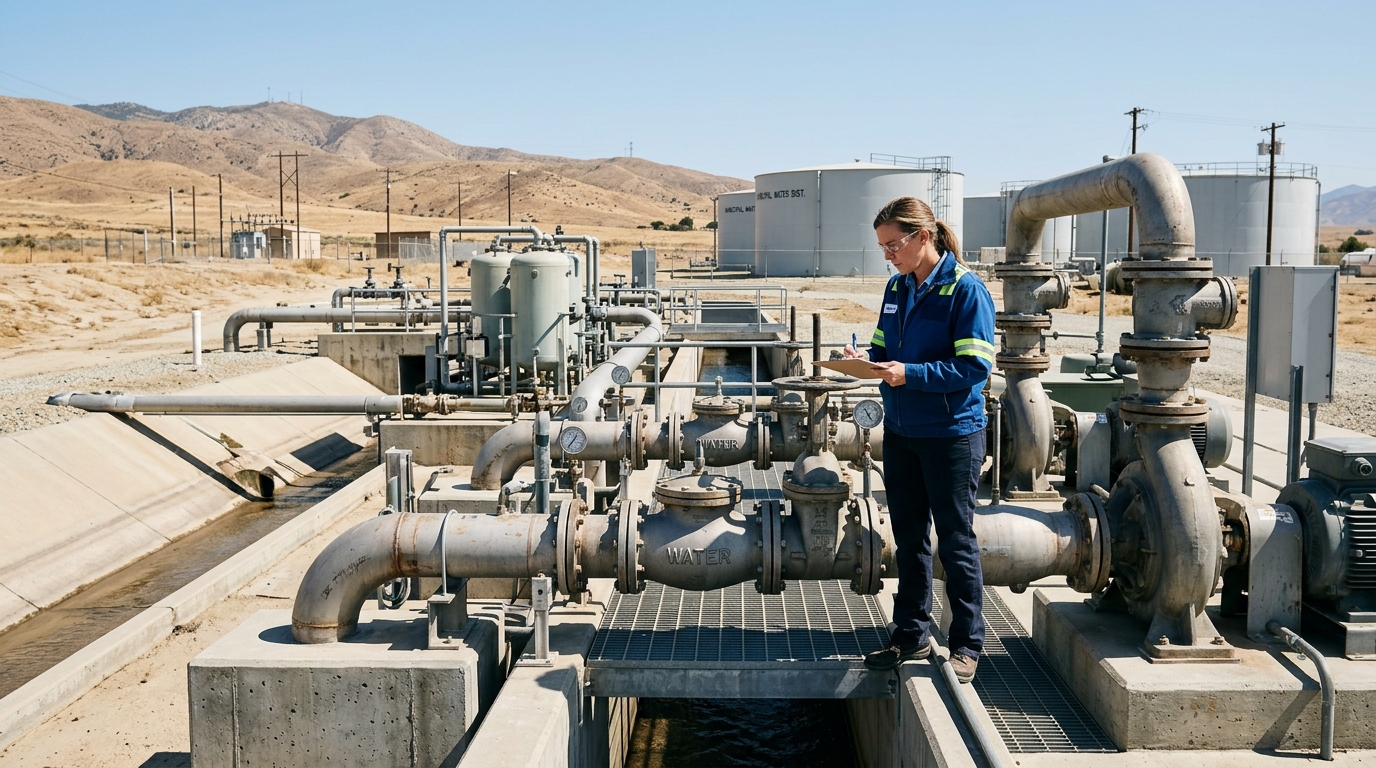
Nobody talks about water. That’s the first thing worth noticing.
In a market obsessed with semiconductors, AI infrastructure, GLP-1 drugs, and rate trades, there’s an entire sector sitting in the background with a structural demand story that may be more durable than almost anything currently getting attention. The companies delivering clean water across the United States are facing accelerating demand from every direction at once — and most investors haven’t looked at the space in years.
Water availability per capita has dropped from over 2,500 cubic meters per year in 1947 to under 600 today — well below the UN’s threshold for water scarcity. U.S. agriculture alone is heading toward an $84 billion water management investment cycle over the next five years, with irrigation spending averaging $13.5 billion annually through 2031. And that’s before you account for the municipal and industrial side.
The Confluence Nobody Is Modeling
Three independent pressures are hitting the water sector simultaneously right now, and none of them are cyclical.
First: infrastructure age. Much of the U.S. water network is decades old. The sector is navigating a $1 trillion national funding gap for pipe replacement, treatment upgrades, and lead-line removal. Federal money helps but doesn’t come close to covering it. Rate cases at state regulators — which allow water utilities to earn returns on their capital investments — are becoming more frequent and more favorable as the urgency becomes politically visible.
Second: PFAS. New EPA regulations require more than $10 billion in remediation costs by 2030, targeting so-called “forever chemicals” in drinking water systems. Public utilities are recovering these costs through rate mechanisms. That means future revenue streams are effectively already approved by regulators before the capex is even deployed. That’s a rare dynamic.
Third: data centers. This one doesn’t show up in the water sector conversations, but it matters. The AI infrastructure buildout that everyone is tracking for semiconductors and power consumption also has a water demand side. Large-scale data centers consume enormous quantities of water for cooling. As hyperscalers expand capacity across the Sun Belt and mid-continent, they are materially increasing local water demand in regions already under stress.
And then early this month, American Water Works was actively urging customers across Maryland and Virginia to conserve water as hotter, drier summer conditions raised drought concerns. This is June. The summer demand spike hasn’t even peaked yet.
Three Names Worth Watching
American Water Works (AWK) is the largest publicly traded water and wastewater utility in the United States, serving nearly 4 million customers across roughly 14 states. Q1 2026 revenue came in at $1.21 billion — up 5.7% year-over-year and 8% above analyst estimates. The company reaffirmed its full-year 2026 adjusted EPS guidance range of $4.90 to $5.30. Revenue is forecast to grow at roughly 7.1% annually over the next three years. The stock has lagged its own earnings growth for three consecutive years, which is either a warning sign or a valuation opportunity depending on your framework. Utilities like AWK leverage a 6-8% rate base CAGR, where state-approved capital investments mechanically drive revenue increases. It’s not exciting. It’s predictable, in the right way.
Xylem (XYL) sits on the technology and equipment side of the water trade. It designs and manufactures pumps, treatment systems, smart metering, and advanced water technology. BNP Paribas flagged both Xylem and Veralto as trading under 21 times earnings — significantly below the mid-20x multiples of their peer group — calling out a market undervaluation. Both have achieved double-digit earnings growth over the past few years, with similar growth expected into 2026. The bear thesis on XYL is peaking demand and funding risk from municipal budget pressure. The bull thesis is that you’re buying a secular infrastructure cycle at a discount to where it has historically traded.
Veralto (VLTO), spun off from Danaher in 2023, focuses on water analytics and product quality. Its Water Quality segment — including the Hach and Trojan Technologies brands — supplies instruments, treatment systems, and ultraviolet disinfection to test and treat drinking water globally. The company has exceeded guidance for two consecutive years, and the market appears to be underestimating the consistency of its execution.
What the Market Is Missing
The water sector doesn’t move fast. It doesn’t have earnings beats that send stocks up 20% in a day. What it has is compounding regulatory certainty — something almost no other sector can say. When a state utility commission approves a rate increase to fund infrastructure investment, that revenue is locked in before the pipe gets replaced. The business model is essentially pre-approved capex monetization. You spend capital, regulators approve recovery, revenues grow.
In an environment where most cyclicals are dealing with margin compression, input cost volatility, and demand uncertainty, the regulated water utilities are running a different playbook entirely. The risk is interest rates — higher borrowing costs pressure utility valuations — which is exactly why the sector has underperformed over the past 24 months. But with rates now at 6.47% and broadly expected to drift lower, that headwind begins to reverse.
The broader water technology names like XYL and VLTO are a different risk profile — more growth-sensitive, less rate-sensitive, more exposed to municipal budget cycles. But they’re also sitting at discounted multiples in a sector with an $84 billion agricultural pipeline and a $10 billion PFAS remediation mandate ahead of them.
Michael Burry flagged water scarcity as a defining investment theme of the 21st century years ago. He wasn’t wrong about the thesis. The timing is the variable. In mid-2026, the alignment of drought conditions, regulatory mandates, data center demand, and a multi-decade infrastructure underfunding cycle is beginning to look less like a slow-moving secular story and more like an inflection.
Most investors are not positioned for it. That’s worth thinking about.