Most of the conversation this week is about tech earnings and the AI selloff. Fine. But while traders were fixated on chips, one of the most institutionally loaded setups in the market has been quietly building for months — and it’s in financials.
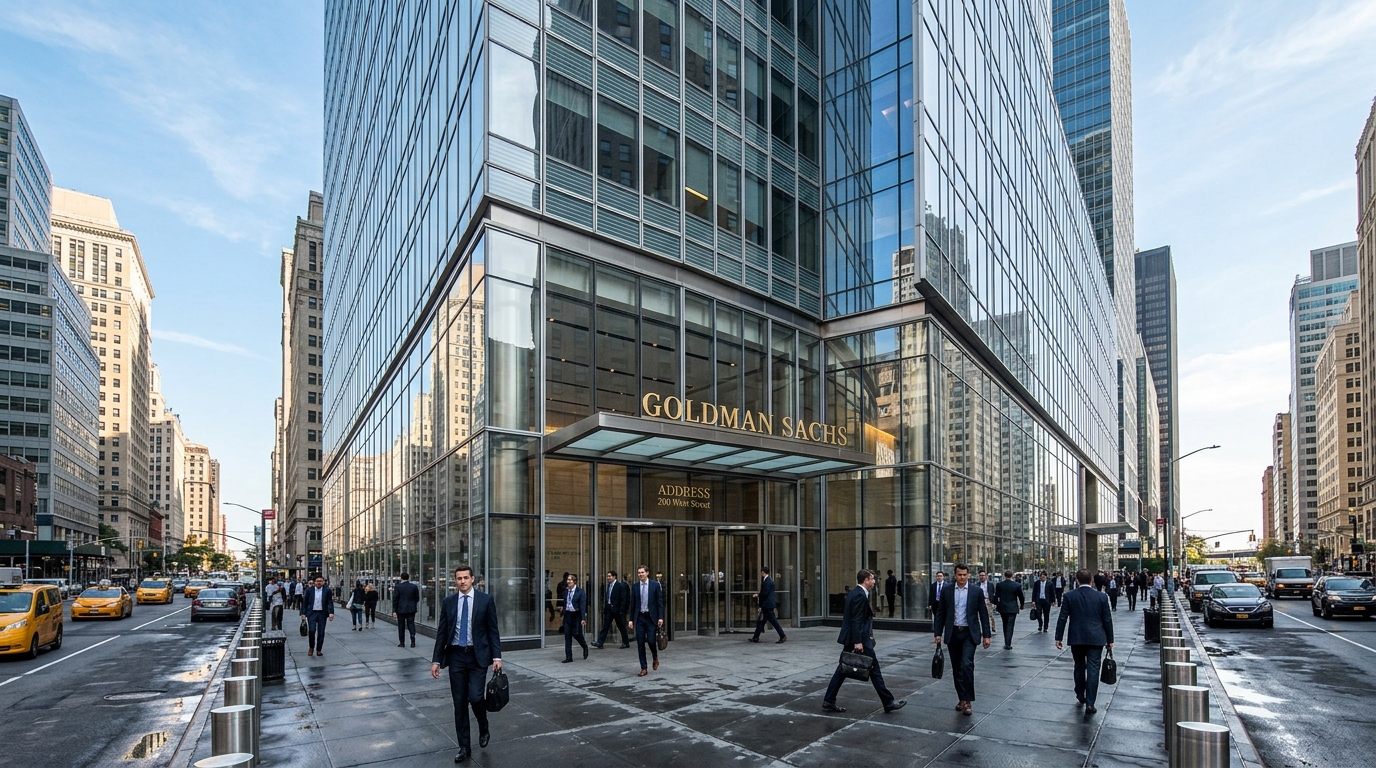
Goldman Sachs (NYSE: GS) recently crossed $1,000 per share for the first time in its history, touching an all-time high of approximately $1,073.97 before pulling back to the $1,040–$1,092 range in recent sessions. The 52-week low was $592.90. That’s an 80%+ move off the floor — not a story the casual observer is tracking.
The Engine Behind It: M&A at Near-Record Pace
Goldman’s president John Waldron said in late May that the firm’s M&A volumes in 2026 are on track to approach — or potentially breach — the 2021 record. The firm retained its global number-one ranking in M&A advisory with a $150 billion lead over its closest peer in announced volumes, closing deals including the $43 billion Unilever/McCormick combination, Sysco’s $29 billion acquisition of Jetro Restaurant Depot, and Coterra Energy’s $26 billion sale to Devon Energy.
Goldman Sachs Global Banking & Markets predicts pure M&A volume could hit $3.8 trillion in 2026, driven by AI-related strategic dealmaking and accelerating private equity deployment. There’s approximately $3 trillion in corporate cash reserves across American companies, and private equity firms are sitting on roughly $2 trillion in dry powder — capital that is actively moving into deals right now.
What’s interesting is the structural nature of this cycle. Unlike the debt-fueled M&A binges of 2005–2007, the current wave is underpinned by strong corporate balance sheets and disciplined dealmaking — AI disruption is forcing companies to acquire rather than build, compressing organic timelines in a way that has no historical analog.
The Q1 2026 Numbers
- Total Q1 revenue: $16.91 billion, up 14.5% year-over-year from $14.78 billion
- Operating income: $6.53 billion, +15.8% YoY — outpacing revenue growth (operating leverage)
- EPS: $17.55, beating consensus of $16.47 by 6.56%
- ROE: 19.8%; $6.4 billion returned to shareholders via buybacks in Q1
- FICC + equities financing revenues: $3.7 billion, up 36% YoY, comprising nearly 40% of total GBM revenues
- Equity trading revenue: Up 27% — record GBM quarter
Goldman also pushed its Fed rate-cut forecast to 2027 following the stronger-than-expected May jobs report (172,000 new jobs added, well above the 80,000–88,000 consensus range). Slightly counterintuitively, that’s bullish for Goldman — higher-for-longer rates extend the period of elevated FICC and credit spreads that feed trading revenues.
Technical Framework
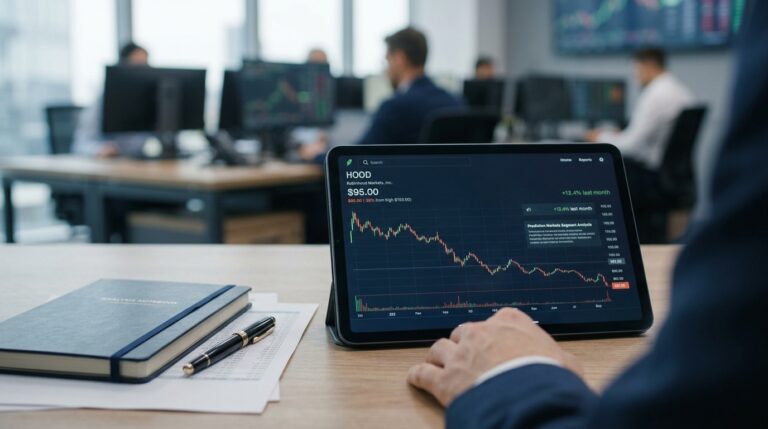
GS is trading in the $1,040–$1,092 zone as of this week, consolidating near all-time highs after a short-term pivot top triggered on June 2. Support levels sit at approximately $1,025 and $954 — a breakdown through either would signal a more meaningful pullback. The broader trend remains constructive: the stock has risen in 8 of the last 10 sessions, and short-term moving averages remain above long-term averages. MACD on the 3-month timeframe is bullish. The consensus analyst price target of $947.60 is now meaningfully below the current price — which creates an interesting divergence between Street targets and actual price discovery. The market is pricing something analysts haven’t fully caught up to yet.
Q2 2026 earnings are on deck for July 14. Watch for advisory revenues sustaining above $1 billion and equities financing holding above $2 billion per quarter — those are the two data points that would confirm structural durability rather than a cyclical peak.
Scenario Modeling
Bull Case: M&A backlog converts aggressively into Q2 and Q3 advisory fees; OpenAI, SpaceX, and Anthropic IPOs (Goldman is involved in multiple mega-deals) generate windfall advisory and underwriting revenues; GS breaks above $1,100 and sustains. Target zone: $1,150–$1,250 by year-end.
Base Case: Activity remains elevated but mean-reverts modestly as Middle East uncertainty creates episodic hesitation in deal completions. GS consolidates between $980–$1,080 into Q2 earnings. Fundamentals remain strong. Execution, not macro, drives the next leg.
Bear Case: Geopolitical escalation (Iran-Israel flare-up) significantly disrupts capital markets activity; equities financing normalizes from the current record $2.6 billion pace; credit conditions tighten. Support at $954 becomes the line in the sand. A break below $900 would re-rate the thesis entirely.
The part people skip: Goldman is also being tapped to lead the Anthropic IPO alongside Morgan Stanley. The IPO calendar alone — OpenAI, SpaceX, Anthropic — represents a pipeline of generational advisory mandates. That optionality isn’t in the current consensus model.
Preparation over prediction. Know your levels, size accordingly, and let the tape confirm the thesis before committing full risk capital.
For informational and educational purposes only. Not investment advice. Trading involves risk, including loss of principal.