
By Jamie McGeever
ORLANDO, Florida, Jan 20 (Reuters) – Stocks, bonds and the dollar tumbled on Tuesday, as U.S. President Donald Trump’s threat to reignite a trade war and sour relations with Europe over Greenland rattled investors, propelling safe-haven gold to yet another record high.
More of that below. In my column today, I look at the latest wave of Trump-fueled uncertainty crashing over world markets, and ask the question: Can investors really adequately price such fundamental shifts in the world’s geopolitical tectonic plates?
If you have more time to read, here are a few articles I recommend to help you make sense of what happened in markets today.
1. Trump, sharing leaked texts and AI mock-ups, vows ‘nogoing back’ on Greenland 2. After Trump salvo, Macron says: we don’t give in tobullies 3. Canada’s Carney aims to lead new global trading orderless reliant on US 4. Debt-ridden global bond markets rattled by Japaneseselloff, Greenland fears 5. ‘Inoculated’ markets should be wary of mutating tariffvirus – Mike Dolan
Today’s Key Market Moves
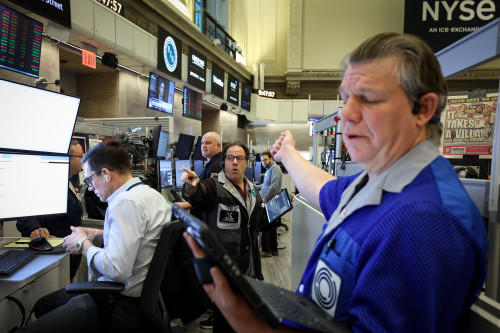
* STOCKS: A sea of red across Asia and Europe, the selloffaccelerating in US hours – S&P 500, Nasdaq down 2% or more. * SECTORS/SHARES: 10 out of 11 sectors in the S&P 500fall. Tech, consumer discretionaries off ~3%, only consumerstaples in the green. Just. Dell -7%, Hewlett Packard -5%, Netflix -4% after the bell following Q4 results. * FX: Dollar falls broadly and steeply. USD index hasworst day since August, Swiss franc has best day sinceSeptember. * BONDS: U.S. Treasury yields up as much as 9 bps at longend, bear steepening the curve. Long-dated JGBs have one oftheir worst days ever, crushed by snap election jitters. * COMMODITIES/METALS: Oil +1.5%, gold +2% to new highabove $4,750/oz. LME copper falls ~2%.
Today’s Talking Points
* ‘De-dollarization’ back with a bang
We got a glimpse around the ‘Liberation Day’ tariff chaos last year of what ‘de-dollarization’ could look like, as investors baulked at U.S. President Donald Trump’s bellicose economic and geopolitical policies, even towards America’s allies.
The trade fizzled out, but could be back with a bang as the world recoils at Trump’s stance on Greenland, and Europe more broadly. The dollar, Treasuries and Wall Street all tanked on Tuesday – a toxic combination that Washington won’t want to see repeated too often. Will markets force Trump to de-escalate?
* The chimes of JGBs crashing
Tuesday was an historic day for Japanese government bonds. Prices plunged on worries around the snap general election called by Prime Minister Sanae Takaichi for February 8. The long end of the curve got crushed, and the 30-year yield rose a record 26 basis points.
There is a danger that Japan is losing control of the long end of the curve, as a ‘doom loop’ of investors dumping JGBs and the country’s rapidly deteriorating fiscal dynamics intensifies. Unless the Bank of Japan steps in, there are few buyers, if any.
* Global risk ratchets up
The global investment landscape at the start of 2026 is an inhospitable one. From Venezuela to Greenland, Iran to Japan, politics and markets are creating severe challenges for investors. Risk is piling upon risk, and implied volatility is accelerating higher.
Big swings in stocks and currencies are hard enough to navigate, but bond market tremors are more dangerous. Surging borrowing costs suggest sovereign debt is no longer a safe haven, but is instead sounding inflation and risk premium alarm bells. Difficult terrain for investors and policymakers alike.
Can you really price global regime change?
U.S. President Donald Trump’s latest foreign policy and trade war salvos are upsetting global markets, but the question is whether these ructions will escalate or fade away, as was the case during the last 12 months.
The latter is probably more likely, but either way, it is apparent that investors are struggling to adequately price the fundamental shifts in the world’s geopolitical tectonic plates.
And the shifts that have already taken place in 2026 are truly breathtaking. The Trump administration has removed the leader of Venezuela, and claimed to be the Latin American country’s de facto ruler.
A violent crackdown on protests in Iran has killed thousands, with the threat of a U.S. response still lingering.
And then there is Trump’s latest push to acquire Greenland from fellow NATO ally Denmark by any means necessary. The U.S.-Europe alliance, and indeed the very rules-based global order built since World War Two appears to be in jeopardy.
The economic and financial terrain is a minefield too. Trump has issued a host of interventionist decrees on issues from credit card rates to mortgage-backed securities, while also pressuring U.S. oil executives to invest billions in Venezuela. And lest we forget, his Justice Department is still threatening to indict Federal Reserve Chair Jerome Powell.
Until now, though, this “Trumpian assault” on the U.S. and global rules-based order – to borrow a phrase from Matt King, founder of Satori Insights – seemed at odds with the relative calm across markets.
That calm is fracturing. The escalating spat between Trump and many of America’s closest European allies has triggered a widespread selloff in stocks, bonds and the dollar. Safe-haven gold has continued to climb, busting through $4,700 per ounce.
This looks like a return of the so-called ‘Sell America’ trade. Yet if last year is any guide, these market jitters may turn out to be speed bumps on the way to new highs rather than roadblocks.
FUNDAMENTALS MATTER, RIGHT?
Putting the geopolitical drama aside, consensus expectations for U.S. economic growth and corporate profits suggest that Wall Street is unlikely to stay down for long.
The International Monetary Fund on Monday raised its 2026 U.S. growth estimate to 2.4% from 2.1% in October, due in part to the huge sums being plowed into artificial-intelligence data centers, chips and power generation.
Moreover, early indications from the fourth quarter earnings season are encouraging. Of the 33 companies in the S&P 500 that have reported so far, 84.8% have notched an earnings beat. If the LSEG consensus estimate for year-on-year earnings growth of 9.0% materializes, that should put upward pressure on equities.
Finally, it’s good to remember that high uncertainty isn’t necessarily bad for growth or profits. In some cases, it could even be positive. Think of the investment needed to fund a global rearmament wave, or to fuel the scramble for energy security and AI independence.
NO ROOM FOR LIMBO
Markets’ relative calm over the past year may partly be the result of a virtuous cycle – or, looked at another way, an illusion. Passive investment funds continue to send a steady flow of capital into credit and equity markets, helping to keep volatility low and prices high. As long as the music is playing, investors will keep dancing.
But the confusing trends of the last year – including simultaneous rallies in both risk-on and risk-off assets – also reflect the fact that it is simply very difficult to accurately price risk of this scale. What value does an investor assign to the end of NATO and the U.S.-Europe alliance, or the emergence of a new multi-polar world carved into three broad “spheres of influence” headed by the U.S., China and Russia?
“For investors, regime change is hard to navigate. It’s like you are either at war or you aren’t at war. There’s no limbo,” says Satori Insights’ Matt King.
“The risk rally is consistent with fundamentals, but not necessarily driven by fundamentals. There’s something very odd about it. You can explain it, but there is a degree of vulnerability about it.”
This applies to corporate earnings too. There’s an assumption that tech and broader earnings will remain at current levels. Threats to the cycle – such as excess AI capacity due to competition from China or regulatory pressure from the EU – don’t appear to be captured in analysts’ forecasts. But those risks still exist.
Perhaps Trump’s push for Greenland will be the straw that breaks investors’ backs, and the current market jitters will turn into a true correction. You might not want to bet on it though.
What could move markets tomorrow?
* World Economic Forum in Davos, including U.S. PresidentDonald Trump, ECB President Christine Lagarde, EuropeanCommission President Ursula von der Leyen * Indonesia interest rate decision * UK inflation (December) * Canada producer price inflation (December) * U.S. Treasury sells $13 billion of 20-year notes atauction * U.S. earnings, including Johnson & Johnson, CharlesSchwab, Truist, Halliburton
Want to receive Trading Day in your inbox every weekday morning? Sign up for my newsletter here.
Opinions expressed are those of the author. They do not reflect the views of Reuters News, which, under the Trust Principles, is committed to integrity, independence, and freedom from bias.
(By Jamie McGeever;)