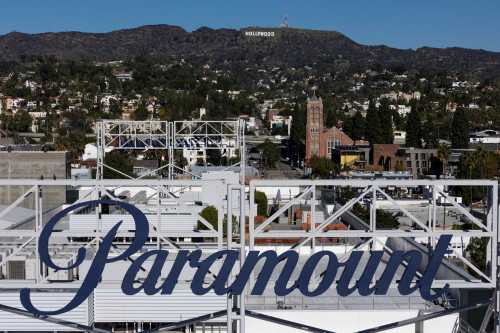
Feb 17 (Reuters) – Warner Bros Discovery has rejected Paramount Skydance’s latest $30-a-share hostile takeover bid but is giving the Hollywood studio seven days to come up with a better offer, Warner Bros said in a statement on Tuesday.
Paramount informally broached an even higher share price of $31 a share, Warner Bros said, apparently enticing the board to the table.
The rival bidder now has until February 23 to submit its “best and final offer”, which Netflix is allowed to match under the terms of the merger agreement, Warner Bros said.
The move marks the latest chapter in the race for Warner Bros’ iconic film and TV studio and its vast library of movies and television shows.
Here is a timeline from the founding of Time Inc and Warner Bros to the company’s latest breakup and potential sale.
Date Event
1922 Time Inc was founded by Henry Luce and
Briton Hadden to house Time magazine, a
weekly news publication that made world
affairs accessible to the average reader.
The first issue of Time magazine was
published in March 1923.
1923 Warner Bros was founded by brothers Harry,
Albert, Sam and Jack Warner as a film
studio in Hollywood. It revolutionized
cinema with the introduction of
synchronized sound in films.
1969 Kinney National Company, a conglomerate
that later transitioned into media, buys
Warner Bros-Seven Arts and later spins off
its non-media businesses.
1972 HBO is founded by Charles Dolan with
backing from Time. It was the first U.S.
subscription-based cable network, offering
uncut, commercial-free movies and live
sports, pioneering premium cable
television.
1990 Time Inc merges with Warner Communications
in a $14 billion deal, hailed as a
“marriage of content and distribution”,
creating Time Warner, then the largest
media company in the world.
1996 Time Warner merges with Turner
Broadcasting, gaining Cartoon Network, CNN,
TNT and a vast film library of classic
films.
2000 Time Warner merges with AOL, forming AOL
Time Warner, the largest merger in history
at the time, aiming to marry traditional
and digital media.
2002 AOL Time Warner merger begins to unravel as
AOL’s value collapses with the launch of an
SEC investigation, prompted by allegations
of accounting irregularities and inflated
revenue reports at AOL.
2003 CEO Steve Case resigns from AOL Time
Warner.
2004 Time Warner sells Warner Music to a private
equity group led by Edgar Bronfman Jr. for
$2.6 billion.
2009 Time Warner fully spins off Time Warner
Cable, which had already been partially
separated in 2007, ending its role in cable
distribution.
2009 Time Warner spins off AOL.
2013 Time Warner spins off Time, its magazine
division, which includes Time, People,
Fortune and Sports Illustrated, marking its
formal exit from publishing.
2016 AT&T announces acquisition of Time
Warner for $85 billion.
2018 AT&T completes its acquisition of Time
Warner after regulator approval, renaming
it WarnerMedia.
2021 AT&T announces it will spin off WarnerMedia
and merge it with Discovery Inc to create a
new standalone media company.
2022 WarnerMedia and Discovery complete their
merger in a $43 billion deal.
June 2025 On June 9, Warner Bros
Discovery announces it will separate into
two companies — one focusing on streaming
and studios businesses, while the second
will house its cable TV assets.
October 2025 On October 21, Warner Bros Discovery’s
board rejects a Paramount Skydance offer of
nearly $60 billion, or $24 per share, a
source familiar with the matter exclusively
tells Reuters. The company says it is
weighing a potential sale amid interest
from several suitors.
November Warner Bros Discovery’s board wants
2025 Paramount Skydance to sweeten its bid to
$30 per share, valuing the company at
$74.34 billion, Axios reports on November
18.
November On November 21, Warner Bros
2025 Discovery receives preliminary buyout bids
from Paramount Skydance, Comcast and
Netflix — who were asked to improve their
offers.
December On December 1, Warner Bros
2025 Discovery receives a second round of bids,
including a mostly cash offer from Netflix.
December Paramount Skydance accuses Warner Bros
2025 Discovery on December 4 of running an
unfair sale process that favors Netflix
over other bidders, CNBC reports, citing a
letter sent by the newly merged media
company.
December Netflix is in exclusive talks
2025 to buy Warner Bros Discovery’s film and
television studios along with its streaming
assets after offering $28 per share, a
source says on December 5
December On December 5, Netflix
2025 agrees to buy Warner Bros
Discovery’s film and TV studios and
streaming division for $72 billion, or
$27.75 per share.
December Paramount Skydance makes a hostile bid for
2025 Warner Bros Discovery on December 9 in a
deal valued at $108.4 billion or $30 per
share.
December On December 17, Warner Bros
2025 Discovery’s board rejects Paramount
Skydance’s hostile $108.4 billion bid,
saying it failed to provide adequate
financing assurances.
December Paramount Skydance amends its offer to buy
2025 Warner Bros Discovery on December 23 to
include a $40.4 billion personal guarantee
from Larry Ellison.
January 2026 On January 7, Warner Bros
Discovery rejects Paramount Skydance’s
amended hostile bid despite Larry Ellison’s
guarantee.
January 2026 On January 12, Paramount
Skydance files lawsuit to force Warner Bros
Discovery to disclose details of its deal
with Netflix and plans to nominate
directors to Warner Bros Discovery’s board.
January 2026 On January 20, Netflix amends
its bid to an all‑cash offer for Warner
Bros Discovery’s studio and streaming units
and secures unanimous approval from the
Warner Bros board without increasing the
$82.7 billion purchase price.
January 2026 On January 22, Paramount
Skydance extends its hostile tender offer
for Warner Bros Discovery to February 20,
seeking more time to win investors.
On February 3, U.S. senators
February grill
2026 Netflix co-CEO Ted Sarandos at
a hearing over how the company’s
acquisition of Warner Bros Discovery would
affect competition in the entertainment
industry.
On February 5, U.S. President
February Donald Trump
2026 says
he will stay out of the
bidding war for Warner Bros Discovery, a
reversal from his
comments
late last year.
On February 10, Paramount
February Skydance
2026 revises
its $30-per-share all-cash
offer for Warner Bros, adding a
25-cent-per-share fee for every quarter the
transaction does not close beyond December
31, 2026. Paramount also said it would fund
the $2.8 billion termination fee Warner
Bros owes Netflix if the deal falls
through.
February On February 17, Warner Bros
2026 rejects Paramount’s revised bid and gives
the Hollywood Studio seven days to see if
it can come up with a better deal to buy
the owner of HBO Max and the “Harry Potter”
franchise.
(Reporting by Kritika Lamba, Meghana Khare, Anhata Rooprai, and Arnav Mishra in Bengaluru; Editing by Leroy Leo, Arun Koyyur, Shinjini Ganguli, Maju Samuel and Pooja Desai)